UA-9726592-1
Showing posts with label vet. Show all posts

Tuesday, September 9, 2014

Where to start in VA disability compensation


First, are you eligible?

A veteran must have two years of active duty under her belt as of a 1981 service entry.

You must have a disability that the VA determines is service-connected on active duty, or was made worse by active military service. You must also have a discharge that the VA determines was under other than dishonorable conditions. For example, you are unlikely to qualify for disability compensation if you have a bad conduct discharge. 
 
The disability compensation conditions are less strict than eligibility for some other benefits such as a VA pension or VA home loans. In both cases, you must have served on active duty during a wartime period such as the Korean War, the Vietnam War or the Gulf Wars.

You have three basic options when you start a claim. You can represent yourself “pro se” or give your Power of Attorney (POA) to a Veterans Service Organization or an attorney. 

Let's look at the pros and cons of each. 

Pro Se

1, You have complete control of your claim. If you have to appeal to the Board of Veteran Appeals (BVA) you get special consideration because you do not have professional representation. You can also ask the BVA for a reconsideration of its ruling, something a veteran service organization or attorney cannot do.

You will be able to go to the VA's Veteran Center that has many experienced counselors who can access most VA claims databases.

In addition, you can usually see the same VA counselor as the claim progresses. The Veterans Center is open 5 -days a week and doesn't close during local or national VA conventions or similar events.

You will have to do all of your own research and file the claim using the On-line VONAPP or the VA paper Form 21-526. You will also have to coordinate the completion of Disability Benefits Questionnaires (DBQ) with your physicians and clinicians to document your claim.

You will have to set up a file system for incoming VA letters and outgoing claims documents. You wail need access the Internet, a PC and a printer, preferably a laser multifunction printer. You will need software that is able to edit postscript document format (PDF) documents such as Adobe Acrobat.

Attorney

An attorney can probably provide the best help up front on a claim. If an attorney takes your case, it is a good sign that your case has merit. The attorneys have paralegals who will help you with paperwork and answer questions by phone. You can expect a higher level of service with an attorney.

Most attorneys will also be able to refer you to doctors who understand the VA's documentation requirements and know how to properly complete a DBQ. The VA Regional Office is likely to take attorney representation more seriously than a claim that is represented pro se or by a veterans organization.

The attorney will receive 20 per cent of any retroactive pay that you receive. However, this does not apply to monthly compensation.in contrast, other private practice attorneys take about 1/3 of a settlement plus administrative costs.

Most veteran attorneys do not provide this services to become wealthy Most have been veterans and understand the need for these legal services to vets.

Veteran Service Organizations

Last but not least are the service organizations such as the Disabled American Veterans (DAV), the Veterans of Foreign Wars (VFW) and the American Veterans (AMVETS). There are many others. Most of the states also have state level veteran service officers(VSO).

These veteran organizations usually require POA. However, this does not restrict you from talking to the counselors in the Veteran Center, On the other hand, an attorney will probably want all conservations and documentation to go through the attorney's office.

The exception of the state service organization who usually will not ask for POA. Have found most service organizations to be the least effective way to staff a claim. Many of these offices have limited hours and may be open only 4-days a week. During a VA conventions the entire office may close. One office rotated its VSOs every 90-days and a vet could have 20 different VSOs or more during the life cycle of a claim.

Service organizations are unlikely to help you write or review claim documentation. Service orgs will represent you during a local BVA hearing, but many VSOs lack legal training. This is true in FL. However, in NY a VSO must have legal training.

The state VSOs are a different animal. Many will help you without requiring POA.Most are unlikely to represent you during a BVA hearing.

So, if you are representing yourself pro se, you can still get advice from both counselors in the vet center and from state level VSOs. In the case of the writer, this situation worked best, but it is not for everyone.

Is Pro Se is for me?

Fist of all can you or your significant other write well? Can you distinguish facts from opinion? How good is your grammar and reading comprehension? 

The BVA has strict rules on evidence. The BVA will throw out any opinion other than expert that you try to present as fact. 

Try some of these tests before you dive into pro se.  Check out the following grammar and reading comprehension tests and your ability to distinguish fact from opinion.


If you are having difficulty with these tests, suggest you engage and attorney. Regardless of whether you start the claim with an attorney, you will probably eventually need one if you appeal to the BVA, which provides legal administrative hearings.

sources:

http://vabenefits.vba.va.gov/vonapp/main.asp

VA Form 21-526

http://www.grammar-monster.com/free_grammar_tests.html

http://www.ereadingworksheets.com/free-reading-worksheets/fact-and-opinion-worksheets/


Subscribe to the Rightardia feed: http://feeds.feedburner.com/blogspot/UFPYA 
  Creative Commons License

Rightardia by Rightard Whitey of Rightardia is licensed under a Creative Commons Attribution 3.0 Unported License.

Permissions beyond the scope of this license may be available at rightardia@gmail.com.

Friday, April 20, 2012

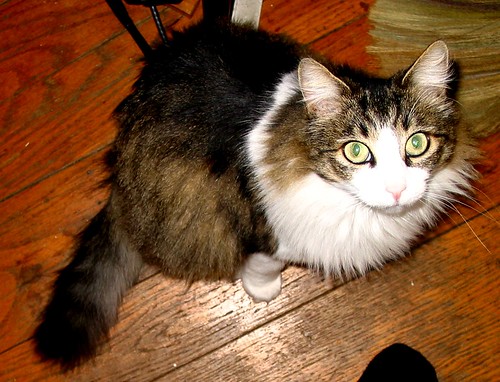
Furball the Cat passes on

Furball looked a lot like Hobo, another Norwegian forest Cat

The major's family  has a cat name Furball. Both he and his wife are cat people. Furball was the Major's my sixth cat. He  knew the average cat lives about 12-14 years.

Furball was between 15 and 16 years old but she appeared outwardly to be a younger cat than she was. She looked like a Norwegian forest Cat and had long silky fir.

About a year ago, she became hyperthyroid which is common for a cat. Once a cat become hyperthyroid, they beg for food all of the time. The cat acted like a food hound in the kitchen and nearly knocked my wife over on more than one occasion with its frantic meowing and pacing for food.

To make maters worse, she was very finicky about her food. If you gave her food that she didn't like, the cat would continue to badger for a different food,

There were other problems as well.We had a hard time litter training her and there were constant accidents all over the house.

When the Major wife took in the cat in for a vet checkup, the vet noticed a mass in her abdomen. A scan  indicated she either had cancer or a large cyst in both her thorax and abdominal area. The cat also had abnormally small kidneys that probably explained her accidents.

The mass in the cat may have also explained why the cat was throwing up large hairballs and food.

Many vets are quite well off and make more than medical doctors. We know of two in the immediate area who are millionaires. In fact, it costs more for a cat ultrasound than it does for a human one. In most cases, people don't have insurance for their animals,

Vets are clever. When you check in the animals, they ask you if you consider the pet a family member or just a pet. Woe is to the pet owner that checks "family member." You will get huge pet bills.

My wife realized that Furball was an old cat and that if she had cancer, she wouldn't be around much longer. So she brought her home and told our children to enjoy the cat while  she was still with us.

In the last week, the cat had started sleeping in the master bedroom with us at night. This wasn't that common suggesting. in retrospect, that the cat wasn't feeling too well.

When I left my house at 1 pm yesterday the cat appeared to be sleeping on a a table. When I returned at aroudn 4 pm, the cat was about in the same position, but it raised its head and meowed when my wife called for it.

At around 6:30 pm one of my sons picked up the cat and realized it was limp and unable to move. He also said that the cat had been moving around during the day and had eaten.

We think the cat either had a stroke or seizure. It's eyes were open and glazed but It was unable to get up. Wife took the cat to the vet who agreed the neurological signs weren't normal.

It was time to make that dreaded command decision.

Furball is not with us anymore.

If I were romantic or religious, we could tell our children that Furball was now heading toward cat heaven.. This was a place where cats could play outdoors all days and catch all the food they needed to eat. A place where there there were no fleas.

Fleas are a real problem for a long haired cat and we had to keep her inside to control them.

Perahps Furball came back to our house like in Ghost to say good-bye to all of us and listened to our comments about her. Perhaps she could now understand us and realize what had been happening to her before she moved on to cat heaven.

I even  thought I saw the cat move on pile of laundry out of the corner of my eye. The cat would like to lay on warm laundry after it was removed from the dryer.

My wife also thought she had heard her meowing.

But our children are too old for such bunk. And so are my wife and I. Death is irreversible.

There are , of course, a lot of cats that need good homes. We have had six, the wife will probably want a seventh . Mother's Day is on the horizon.

Good-bye, Furball. You were a great cat, but you were also a burden as you got older.

--the end--

Subscribe to the Rightardia feed: http://feeds.feedburner.com/blogspot/UFPYA

Creative Commons License


Rightardia by Rightard Whitey of Rightardia is licensed under a Creative Commons Attribution 3.0 Unported License.

Permissions beyond the scope of this license may be available at rightardia@gmail.com.

Sunday, February 14, 2010

DAV publishes 2006 vet voting records of Washington politicians


If you are a Veteran and are voting Republican, you might want to check out the voting record of you representative and senator. The DAV report makes it clear that the Democratic Party support vets better than the GOP.

Formed in 1920 and chartered by Congress in 1932, the million-member Disabled American Veterans (DAV) is the official voice of America's service-connected disabled veterans -- a strong, insistent voice that represents all of America's 2.1 million disabled veterans, their families and survivors.

source: http://www.votesmart.org/issue_rating_detail.php?r_id=3483

Also see http://www.dav.org

Subscribe to the Rightardia feed: feeds.feedburner.com/blogspot/IGiu

Netcraft rank: 5222 http://toolbar.netcraft.com/site_report?url=http://rightardia.blogspot.com

Tuesday, August 18, 2009

How to win a VA appeal


The Major got good news from the Board of Veterans Appeals (BVA) today. He prevailed in an eight year claim against the Veterans Administration (VA) that appeared to be heading to Court of Appeals for Veterans Claims in Washington DC.

Rightardia (RI) interviewed The Major (MAJ) about his long ordeal.

RI: What kind of advice would you give other veterans that are filing claims with the VA?

MAJ: Do it now! The Republicans and their appointees were replaced by Democrats in 2009. You have a better chance of getting justice when Democrats are running the VA. The Republicans support the active duty military because they usually start a war when a Republican is president.

George W. Bush even thought he needed to earn his spurs as a commander in chief by starting a the Iraq War. However, the GOP is less concerned about vets and many vet organizations like the Iraq and Afghanistan veterans actually supported Obama during the election.

RI: How did you do to get started with the claim?

The Department of Veteran Affairs has advice and a document list at http://www.gmasw.com/vaclaim.htm.You need your DD form 214 military record of service, your marriage certificate (if currently married), divorce papers or death certificate for all prior marriages of either the veteran or spouse/widow(er), birth certificates for all children being claimed as dependants between 18 &23, and doctor's statement (s)

These doctor's statements should make reference to medical findings, treatment, diagnosis, and prognosis. A widow(er): Should submit veteran's death certificate instead of a doctor's statement (s). You should also submit the Social Security number for each family member and income data for each family member. You may be asked for current value of savings accounts, real estate (excluding home), or non-essential personal property.

You should submit your initial claim to any VA office or medical center on VA Form 21-256. You can ask for help from a Veteran's Service Officer (VSO) from the State Veterans Affair Office, Amvets, VFW, or the American Legion.

The Major recommends checking around on the reputation of the different organizations. He had three different VSOs during the claim's process and one was good, one was bad and one was fugli. He actually had to 'fire' the fugli one.

A veteran has one year after leaving active duty to file a claim. The Major recommends all vets do this when they leave the service because they may have hidden medical conditions. It also important that the veterans leave the service with a copy of his or her medical records.

These records will be essential in the claim. The major also recommends the the vet does the paperwork themselves and have the VSO review it. Unless you have limited writing skills, don't give the VSO you power of attorney. One of our VSOs (the fugli one) was submitting claim documents in The Major's name without The Major's knowledge.

RI: You told us that your wife was involved with the claim.

MAJ: Yes, she contacted a congressional office after the claim had been dragging on for five years and we got some good advice from a congressional staffer. She also kept close track of all of the dates and times we visited the VA and related offices. Her recall of dates was very helpful when I wrote the appeal. She also reviewed all of the documents I submitted to the VA and the second set of eyes helped a lot.

RI: What would you recommend the vet do when he or she submits the initial claim on the VA Form 21-256?

MAJ: Vets should have a time-line that show how the condition progressed in the medical records. It should be documented with attachments from the medical records. The vet should try to show cause and effect.

In my case, I developed a serious endocrine problems while I was in the Air Force while working in a industrial photo lab. I was exposed to all sorts of chemicals in an era before OSHA. An allergy clinic documented the symptoms I was experiencing in the the photo lab.

The duty in the photo lab was the causal factor. I then used my medical records to document the numerous visits to the base hospitals and clinics that ensued afterward.

RI: Why are civilian doctors important?

MAJ: The VA will not accept lay testimony at all. You need one or more letters from a medical doctor that agrees that your medical condition was caused 'more likely than not' while you were on active duty. Use a board certified doctor whenever possible.
I suggest you try to find a doctor that is a 'VA virgin.' This would be a doctor who has never worked for the VA in any capacity. I talked to different doctors and discovered that most doctors who had formerly worked for the VA were skeptical and unhelpful. Most of these doctors do not desire to 'rock the VA boat.'


One of 'these former VA' neurologists I consulted with on my condition said it was very common and he doesn't even tell his patients they had this particular problem when he noticed it during an MRI. My condition is actually a rare disease that occurs in 1:200,000 people. This neurologist also suggested I was born with the condition.

My endocrinologist said had I been born this way I would have been of short stature and unable to have any children. I am more than six feet tall and have three children.

I knew the neurologist was a misinformed because the endocrine problem I had could lead to death if my endocrinologist had not diagnosed it. My endocrinologist laughed when I discussed this neurologist's comments.

Another doctor who was a former USN physician and an occupational specialist looked at a draft document I worked on and suggested it was more or less a lost cause and the document needed more polish. He then asked if a had post traumatic stress disorder because that is what he liked to treat.He also tried to talk me down regarding the percentage of disability that I was asking for.

My condition which was an endocrine condition often masquerades itself as a cardiac condition because of low pulse. A Doctor of Osteopathy assured me my heart was OK, but that I needed to read a book to prepare for the end of my life. About a year later, I discovered I really had an endocrine problem.

I also got a second opinion from another endocrinologist who provides services to the VA. He said my hidden endocrine condition would be hard to prove because it started many years ago. He didn't give me much hope and was very cynical.

All four of these doctors,who had worked for or provided services to the VA, were wrong in some respect. My appeal to the VA was successful so don't let these bastards get you down!
RI: Do you have any other advice?

MAJ: if you have limited writing skills, get someone like a legal aide to help you right the original claim and any appeals. Have your SVO and congressional staffers review the documentation before you submit it. Document, document and document. Show a time-line and cause and effect. Write a draft letter for you doctor and email him or give him a CD with the word processing document so the doctor can edit it. The VA is looking for certain terminology like 'more likely than not' occurred on active duty. Use those buzz words.

In my case I mentioned the endocrine problem to the cardiologist who was treating me and he was flabbergasted. He had only seen my condition in a text book. He also offered to write a letter on my behalf. I didn't even have to ask him to write it. So my appeals had two letters from board certified doctors in it. Both letters were mentioned prominently in the BVA concurrence with my appeal.

RI: How do you avoid a remand?

MAJ: Yes, get a civilian doctor to perform a physical and also have the doctor review you military medical records. Indicate the physical and the medical records review was completed by a civilian doctor in the initial claim and any appeal. This will prevent the BVA from remanding the appeal back to the hospital if the hospital forgets to give you a physical or a records review.

If you have done your home work, the appeal before a judge will be straight forward. Bring your spouse to the hearing. He or she may be able to add details you neglected to mention. I will not wish any veteran good luck because a VA appeal is more about writing skills and documenting your disability than luck. Praying is of no benefit either, but you are welcome to try that if you are religious.

By the way the documentation you submit to the BVA must be used as is and without modification if you appeal to Court of Appeals for Veterans Claims in Washington DC. This means documentation you submit to the BVA must be complete and accurate. Of interest nearly 80 per cent of the cases that are reviewed by the Court of Appeals are overturned or remanded.

Get 30 days of free traffic analysis simply by going to Web-Stat: http://www.web-stat.com/?id=2955

Subscribe to the Rightardia feed: feeds.feedburner.com/blogspot/IGiu

Improve blog traffic with TrafficG http://trafficg.com/splash/splash01.php?uid=eelder1

Netcraft rank: 16596 http://toolbar.netcraft.com/stats/topsites?s=BE281D838226A4DAC11D0E201A0E#16596

Saturday, July 18, 2009

When do you stop supporting the troops?


The GOP talked a lot about supporting the troops during the Iraq War, but has a dismal record on supporting veteran programs. In fact, many veteran's groups openly opposed John McCain in the last election because of his voting record on vet programs. Of course, McCain receives a fat USN pension of $65,000 a year as a retired captain.

According to the 'Down with Tyranny' blog:

"Pick almost any Republican member of Congress-- either house-- and look at his or her voting record on support for our troops or for support for our vets and you'll probably be astonished. Not every single member rates a zero-- but most do and not a single Republican member of Congress-- not one has been supportive of the troops or of our returning veterans."

Republicans who do not support vet programs are  Mario Diaz-Balart (R-FL), Tim Walberg (R-MI), Scott Garrett (R-NJ), David Dreier (R-CA), Ric Keller (R-FL), Randy Kuhl (R-NY), Michael McCaul (R-TX), Mike Pence (R-IN), Dave Reichert (R-WA), Dana Rohrabacher (R-OH), and Mean Jean Schmidt (R-OH). Some of them were voted out of office or retired in the 2008 elections.


http://washingtonindependent.com/6533/veterans-groups-question-mccain-voting-record


http://downwithtyranny.blogspot.com/2008/06/republican-actions-against-military.html

Get 30 days of free traffic analysis simply by going to Web-Stat: http://www.web-stat.com/?id=2955


Contact Rightardia: eelder1@gmail.com


Subscribe to the Rightardia feed: feeds.feedburner.com/blogspot/IGiu


Improve blog traffic with TrafficG http://trafficg.com/splash/splash01.php?uid=eelder1


Netcraft rank: 44637