UA-9726592-1
Showing posts with label vote supression. Show all posts

Saturday, November 10, 2012

Blame this jerk for the FL voting debacle


He tried to suppress votes so his one per cent friend, Mittens, could win.

It didn't work.

He made FL the laughing stock of the nation. FL was the last state to tabulate its presidential vote.

Subscribe to the Rightardia feed: http://feeds.feedburner.com/blogspot/UFPYA

Creative Commons License

Rightardia by Rightard Whitey of Rightardia is licensed under a Creative Commons Attribution 3.0 Unported License.

Permissions beyond the scope of this license may be available at rightardia@gmail.com.

Thursday, October 27, 2011

Daytona Beach News Journal: Teacher faces huge fines for registering students to vote


NEW SMYRNA BEACH -- The teacher who heads up New Smyrna Beach High School's student government association could face thousands of dollars in fines. Her transgression? Helping students register to vote.
Prepping 17-year-olds for the privileges and responsibilities of voting in a democracy is nothing new for civics teachers, but when Jill Cicciarelli organized a drive at the start of the school year to get students pre-registered, she ran afoul of Florida's new and controversial election law.

Among other things, the new rules require that third parties who sign up new voters register with the state and that they submit applications within 48 hours. The law also reduces the time for early voting from 14 days to eight and requires voters who want to give a new address at the polls to use a provisional ballot.

Republican lawmakers who backed the rules said they were necessary to reduce voter fraud. Critics -- including U.S. Sen. Bill Nelson, who testified before a congressional committee -- said the law would suppress voter participation.

The American Civil Liberties Union has filed suit to block implementation of the law. The most controversial elements are under review in federal court before they can be implemented in five counties.

Fear of violating the new rules prompted the League of Women Voters to suspend voter registration efforts in Florida. Local political activists in both parties have been similarly stymied, Volusia County Supervisor of Elections Ann McFall said.

"It's bizarre," McFall said of the law. "I haven't found one person who likes this law."

When McFall heard the story of the New Smyrna Beach teacher at a staff meeting this month -- and realized her office would have to report the incident to the state as a potential violation -- she had a sick feeling in her stomach.

"This isn't someone who was going to commit fraud," McFall said. "She was doing a good thing. New Smyrna Beach High School was doing a good thing."

But Cicciarelli hadn't registered with the state before beginning the registration drive. And she didn't submit the forms to the elections office on time.

In the absence of willful fraud or someone's voting rights being denied, it seems unlikely she would face a fine. Since the law took effect in July, the state Division of Elections has issued only warnings. No incident has been turned over to the attorney general's office for enforcement, said Chris Cate, a spokesman with the secretary of state's office.

"We'll review it, go over the facts and decide whether to forward it," Cate said.

Cicciarelli, who grew up in Port Orange and has been teaching at the school about six years, remembers when she first registered in 1994 while a student at Florida State University in Tallahassee. Volunteers staffing a table for the League of Women Voters helped her navigate a process that seemed a little intimidating to a teen-ager who'd never voted.

"It was such a big thrill to register," she recalled, one that she looks to pass along to the students at her school.

"I just want them to be participating in our democracy," she said. "The more participation we have, the stronger our democracy will be."

Next year Cicciarelli said she would invite a representative from the elections office to give students an opportunity to register. Shannon Miller, a 17-year-old senior who serves as co-president of the student government association along with classmate Crystal Merrick, said she was glad she had the chance to register at school. She wonders how many of her peers will participate if the process is too formalized.

"It may discourage some students (from registering) if it's more difficult," she said. "We're more apt to get involved, but (some students) won't go to the trouble if they think it's hard."

Cicciarelli was on maternity leave in the spring when the Republican-led Legislature adopted the new rules, largely on party lines. Supporters said it was necessary to prevent voter fraud, though elections supervisors like McFall said they haven't had a problem.

"I don't see it," she said in a telephone interview last week from her office in DeLand. "I truly don't see it."

But supporters of the law view it as an attempt to be proactive at a time when elections are becoming so contentious that the potential for fraud is always a threat.

"There are reasons for the law," said state Rep. Dorothy Hukill, a Republican from Port Orange who voted for it. "Part of the reason is to protect people like (the students), so they know they're being registered properly."

It's still easy to register to vote, Hukill added, even if it means third-party groups that want to hold registration drives might have to do some more homework in advance.

"It does point out the need for more public education," Hukill added. "I applaud the poor teacher's efforts to get her students involved. She just didn't know. It just goes to show if you're going to do something, make sure you know what the law says about it."

For the students involved in the voter registration drive, the incident has proven an unsolicited lesson in real-life civics, New Smyrna Beach High Principal Jim Tager said.

"You're talking about a high-energy teacher who cares about her kids, cares about her community and cares about her country," he said. "We want to do things by the rules. We just didn't know about these. In the end, I think this has become a good real-life lesson."
Subscribe to the Rightardia feed: http://feeds.feedburner.com/blogspot/UFPYA  

 Creative Commons License
Rightardia by Rightard Whitey of Rightardia is licensed under a Creative Commons Attribution 3.0 Unported License.

Permissions beyond the scope of this license may be available at rightardia@gmail.com.

Thursday, July 21, 2011

Colbert Report: Voter ID Laws are too liberal


To safeguard against voter fraud and ensure that only the right people get elected, Republican lawmakers pass laws requiring voters to show government-issued photo IDs. (06:33)

Subscribe to the Rightardia feed: http://feeds.feedburner.com/blogspot/UFPYA   Netcraft rank: 6627 http://toolbar.netcraft.com/site_report?url=http://rightardia.blogspot.com Creative Commons License
Rightardia by Rightard Whitey of Rightardia is licensed under a Creative Commons Attribution 3.0 Unported License.
Permissions beyond the scope of this license may be available at rightardia@gmail.com.

Thursday, June 30, 2011

Florida Democratic Party objects to Florida’s Omnibus Elections Law Bill


The Florida Democratic Party (“FDP”) objects to the pre-clearance of Florida’s Omnibus Elections Law Bill, which the Florida Department of State submitted on or about June 8, 2011.

The FDP believes the following provisions of Chapter 2011-40, Laws of Florida, violate Section 5 of the Voting Rights Act. Specific violations are:

(1) Section 39, which reduces the number of days for early voting from fourteen to eight, and gives local supervisors of elections discretion over early voting hours;

(2) Section 26, which eliminates the right of registered voters who move from one Florida county to another to change their addresses at the time of voting, and instead requiring the voter to cast a provisional ballot; and

(3) Section 4, which requires any third-party organization engaging in voter registration efforts to submit voter registration applications within 48 hours of receipt, or face penalties of $50 per application per day late, and imposing fines of up to $1,000 for failing to comply with other provisions.1

In addition, the Florida Department of State’s submission omits certain required contents, namely, Emergency Rules promulgated by the Florida Division of Elections to implement Chapter 2011-40’s amendments to the third-party voter registration laws, which are also problematic.

Rightardia hopes that the Obama administration rejects the act which was intended to suppress voting, particularly of minorities.

Early voting in Florida has been allowed for 15-days prior to the election for the past 40 years in Florida. Light voter turnouts invariably benefit the militant ideologues of the GOP.

Democrats would be wise to request absentee ballots prior to the next election. See http://election.dos.state.fl.us/voting/absentee.shtml

See Florida Democratic party chairman Rod Smith's letter to the Voting Section
of the Civil Rights Division, United States Department of Justice at http://fladems.3cdn.net/bff8f0ca9e965bb2eb_udm6iiokf.pdf


Subscribe to the Rightardia feed: http://feeds.feedburner.com/blogspot/UFPYA%20%20  Netcraft rank: 6627 http://toolbar.netcraft.com/site_report?url=http://rightardia.blogspot.com Creative Commons License


Rightardia by Rightard Whitey of Rightardia is licensed under a Creative Commons Attribution 3.0 Unported License.
Permissions beyond the scope of this license may be available at http://draft.blogger.com/rightardia@gmail.com.

Monday, May 2, 2011

Florida legislature passes vote suppression bills


TALLAHASSEE – Floridians are concerned about a legislative proposal they say would dramatically alter access to the voting booths. the groups  plan to raise their voices in opposition at the state Capitol on Monday morning. 
U.S. Sen. Bill Nelson said: 
We’ve got kids dying in wars for Democracy – and the right to vote is Democracy. This piece of legislation would hinder that right for an awful lot of people.
In fact, several supervisors of elections in Florida already have estimated the measure  would cut early voting from 14 days to six. This will disenfranchise a significant number of voters. 
Rightardia believes that is the purpose of the bill: to suppress voting. Jeb bush did the same thing in 2001 and handed a presidential win to his brother, GW Bush. 
The legislation also prohibits address changes on Election Day would result in longer lines at the polls and, thus, discourage many voters. 
Those forced to cast these “provisional” ballots might never see those votes counted. 
The legislation also imposes heavy restrictions on third-party registration groups along with delivering broad authority to the state attorney general to initiate action against them without any evidence of any wrongdoing.
Senate Democratic Leader Nan Rich ( D-Weston ) stated: 
This bill makes it harder to register voters, harder to cast a ballot and harder still to have a ballot counted,” said state . “It’s stacking the Republican deck one year out from a presidential election by attempting to silence the voices of dissent.
Both HB 1355 and SB 2086 – have already has passed the full House and Senate. 

source: http://capitalsoup.com/2011/05/02/opposition-growing-to-proposed-curbs-on-early-voting-2/

Subscribe to the Rightardia feed: http://feeds.feedburner.com/blogspot/UFPYA  


Netcraft rank: 5841 http://toolbar.netcraft.com/site_report?url=http://rightardia.blogspot.com
Creative Commons License
Rightardia by Rightard Whitey of Rightardia is licensed under a Creative Commons Attribution 3.0 Unported License.
Permissions beyond the scope of this license may be available at rightardia@gmail.com.

Thursday, April 7, 2011

Steve Kangas: What do liberals believe about democracy?

Starship Troopers: The Fascist view of voting

Liberals are probably the strongest advocates of democracy. Democracy solves a problem described by an old adage: "Power corrupts, and absolute power corrupts absolutely."

When power or wealth concentrates too heavily in too few hands in society, democracy is useful for dispersing much of that power back to the people.

In other words, when enough voters become discontented with the status quo, they vote to change it.

Of course, those already in power bitterly resent this; that is why there is such a strong anti-democratic streak in wealthy conservatives and business owners.

They complain that democracy allows the poor to legally steal from the rich. (Liberals counter that unregulated capitalism allows the rich to exploit and therefore steal from the poor, and taxes simply correct for that.)

But democracy also works in the other direction as well. If we lived in a society where everyone was paid equally, despite their different inputs, people would surely vote to create a system of incentives and rewards.

Democracy therefore strikes the balance between the corruption of absolute power and the lack of incentives, between unrestricted meritocracy and egalitarianism. It is the primary tool of moderated meritocracy.

Most liberals favor strengthening our democratic institutions; examples include mandatory voting, state or national referendums and initiatives, and expanded voter registration like the "Motor-Voter" law.

Some go so far as to advocate direct democracy, in which the people, not their representatives, vote directly on legislation.

However, an educated electorate is necessary for the success of any democracy, and there is a real question as to whether the public is educated or informed enough to vote directly on the nuts and bolts of government policies.


Steve passed away under suspicious circumstances but Rightardia views him as a modern day liberal philosopher. 


Republicans like to refer to the US as a republic which is a very abstract term: China , Afghanistan and Iraq are all republics. The US , in fact, is an indirect democracy. We elect people to represent us at the local state and federal level.


You cannot miss the fact that Republicans try to suppress voting by changing voting law by requiring rigorous ID requirements or by changing other voting rules.


In Florida, you can vote and change your address on election day. The Florida legislature is changing the law so such voters who change their address will be given provisional ballots that can be thrown out.


Tea Party Nation president Judson Phillips thinks only people who own property should be able to vote.


This is actually the way it was when the nation was founded. Only about 10- to 16 per cent of the population was allowed to vote.  Black males were not allowed to vote until after the Civil War and women were not give suffrage until the early 20th Century.


This is reminiscent of the fascist film, Starship Troopers. In the film only people who served in the armed forces had citizenship and could vote. 

source: http://www.huppi.com/kangaroo/ShortFAQ.htm#liberalism


Subscribe to the Rightardia feed: http://feeds.feedburner.com/blogspot/UFPYA  

Netcraft rank: 6156 http://toolbar.netcraft.com/site_report?url=http://rightardia.blogspot.com
  Creative Commons License
Rightardia by Rightard Whitey of Rightardia is licensed under a Creative Commons Attribution 3.0 Unported License.

Permissions beyond the scope of this license may be available at rightardia@gmail.com.

Sunday, April 3, 2011

Capital Soup.com: FL Republicans plan to change election law to supress votes

April 1, 2011 

TALLAHASSEE, FL – A 128-page rewrite of Florida’s election laws drew opposition and harsh scrutiny today from election supervisors, grassroots political organizers and Democratic members of the House Governmental Operations Subcommittee.

The Republican-drawn committee substitute of House Bill 1355 was substantially expanded from its original version and was presented to committee members today under short notice.

While the bill sponsor, Rep. Dennis Baxley (R-Ocala), characterized the measure as a “cleanup bill” in advance of the 2012 elections, Democratic legislators noted that the rewritten measure includes highly controversial provisions, including ones that could inhibit voter participation in elections and make it harder to register new voters.

For instance, one component of the bill would end the long-held practice of allowing voters to update their voting addresses at the polls on Election Day. . .

The bill says those people would be allowed only to cast provisional ballots. Such ballots are often not counted.

Democratic caucus members on the committee voted against the bill . . .

Rep. Jeff Clemens, the Democratic ranking member on the committee, led the questioning in committee Friday. He issued the following statement:

Each day in the Legislature, seriously flawed legislation is being passed out of committees under the presumption that it will be fixed later. Why don’t we fix these bills now? The language in this elections bill seems to place a presumption of guilt on the voters. Voters shouldn’t need to jump through hoops in order to exercise their constitutional rights.


Subscribe to the Rightardia feed: http://feeds.feedburner.com/blogspot/UFPYA   Netcraft rank: 6237 http://toolbar.netcraft.com/site_report?url=http://rightardia.blogspot.com Creative Commons License
Rightardia by Rightard Whitey of Rightardia is licensed under a Creative Commons Attribution 3.0 Unported License.
Permissions beyond the scope of this license may be available at rightardia@gmail.com.

Thursday, October 28, 2010

Funny or die: Please, vote


Reagarless of your political views, exercise your constitutional right to vote. That is the american Way!

Subscribe to the Rightardia feed: feeds.feedburner.com/blogspot/IGiu 

Netcraft rank: 8550 http://toolbar.netcraft.com/site_report?url=http://rightardia.blogspot.com

Tuesday, December 1, 2009

Politico: Judge rejects RNC bid to end minority voter protections


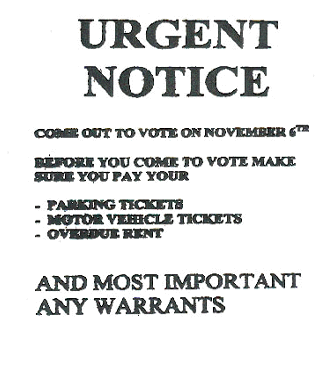
This is a good example of voter suppression. Americans vote on Nov. 4, not November 6. Republicans have even called voters on the phone and provided false election dates.

By KENNETH P. VOGEL | 12/1/09 8:07 PM EST

A federal judge in New Jersey on Tuesday rejected an attempt by the Republican National Committee to end nearly three-decade-old restrictions on GOP "ballot security" programs that historically discriminated against minority voters.

In a ruling that extended the restrictions for at least another eight years, but also slightly narrowed the consent decree containing them, U.S. District Court Judge Dickinson Debevoise of Newark asserted that “voter intimidation presents an ongoing threat to the participation of minority individuals in the political process.”

The consent decree stems from a lawsuit brought in the early 1980s in New Jersey by the Democratic National Committee, which accused the Republican National Committee of suppressing minority voters under the guise of guarding against voter fraud, partly by challenging their registrations if mail sent to their residences was returned as undeliverable, and by stationing off-duty police around polling places in minority neighborhoods.

The resulting consent decree, which barred the RNC from launching any ballot security programs without prior court approval, was expanded in 1987 to cover the entire country.

But the RNC, in a motion filed with little fanfare the day before Barack Obama’s historic presidential election victory, argued that since the 1980s, the risk of fraud has increased, while the need for minority voter protection measures has decreased.

The DNC countered that the RNC was exaggerating the danger of voter fraud and said the potential for such fraud is outweighed by the risk of voter intimidation efforts by Republican groups, pointing to a recent decision by the New Jersey court that the RNC had engaged in illegal voter challenges as recently as the 2004 presidential election.

The RNC contended that the consent decree had been interpreted too broadly and made it tougher for Republicans to ensure an even electoral playing field.

Plus, it said it had no incentive to intimidate minority voters, pointing to its own election of Michael Steele, who is African-American, as chairman, and asserting that Obama’s election meant existing voting rights laws would be adequate to protect minority voters without the decree.

DNC Chairman Tim Kaine, in a statement, shot back that “Republicans would be better served trying to engage minority and under-represented voters rather than trying to intimidate them.”


Rightardia applauds the judge for making the right decision. The GOP has been supressing voters since the great Depression when black Americans started voting Democratic. Prior to presidential primary in Florida, thousands of black voters were purged form the voter rolls.  This purge gave the election to George W. Bush. Jeb Bush was the governor of Florida and Katherine Harris was the Secretary of the State when this occurred.


In May 2000, DBT discovered that approximately 8,000 names were erroneously placed on the exclusion list, mostly those of former Texas prisoners who were included on a DBT list that turned out never to have been convicted of more than a misdemeanor

Later in the month, DBT provided a revised list to the Division of Elections (DOE) containing a total of 173,127 persons. Of those included on the "corrected list", 57,746 were identified as felons.

According to the Palm Beach Post, among other problems with the list, although blacks accounted for 88% of those removed from the rolls, they made up only about 11% of Florida's voters.

Voter demographics authority David Bositis, a senior research associate at the Joint Center for Political and Economic Studies in Washington, DC, reviewed The Nation's findings and concluded that the purge-and-block program was "a patently obvious technique to discriminate against black voters". 

He noted that based on nationwide conviction rates, African-Americans would account for 46% of the ex-felon group wrongly disfranchised.

source: http://www.politico.com/news/stories/1209/30082_Page2.html
Subscribe to the Rightardia feed: feeds.feedburner.com/blogspot/IGiu

Netcraft rank: 4763 http://toolbar.netcraft.com/site_report?url=http://rightardia.blogspot.com


Powered by ScribeFire.