UA-9726592-1
Showing posts with label government. Show all posts

Tuesday, October 2, 2012

Government in the bedroom is our way

graphic: All Hat NoCatle

Subscribe to the Rightardia feed: http://feeds.feedburner.com/blogspot/UFPYA

Creative Commons License

Rightardia by Rightard Whitey of Rightardia is licensed under a Creative Commons Attribution 3.0 Unported License.

Permissions beyond the scope of this license may be available at rightardia@gmail.com.

Thursday, February 16, 2012

More evidence the GOP Maine caucuses were fraudulent


Uploaded by  on Feb 15, 2012

Rachel Maddow lays out some of the evidence of fraud that robbed Dr. Paul of the official win in Maine.

Ron Paul is not being aggressive about this because he doesn't want to damage his son's, Rand Paul, chances with the Republican Party in the future.

Paul 'lost" the Maine election by 194 votes. it appears that Establishment Republicans are trying to rig the caucuses in Mitten's favor.

Update: The Maine Republican Party has added the additional votes accidentally omitted from Saturday’s caucus results, state party chairman Charlie Webster told The Daily Caller. But those votes won’t be publicly released until March 10.

Webster indicated the Romney lead had increased.

License: Standard YouTube License

Subscribe to the Rightardia feed: http://feeds.feedburner.com/blogspot/UFPYA
Creative Commons License


Rightardia by Rightard Whitey of Rightardia is licensed under a Creative Commons Attribution 3.0 Unported License.

Permissions beyond the scope of this license may be available at rightardia@gmail.com.

Sunday, May 29, 2011

Rightardia editorial: The function of government


According to Wikipedia:

Capitalism is an economic system in which the means of production are privately owned and operated for profit. Income in a Capitalist system takes at least two forms, profit on the one hand and wages on the other.

Socialism is an economic system in which the means of production are publicly or commonly owned and controlled co-operatively, or a political philosophy advocating such a system. 

Collectivism is any philosophic, political, economic or social outlook that emphasizes the interdependence of every human in some collective group and the priority of group goals over individual goals. Collectivists usually focus on community, society or nation.

Collectivism has been widely used to refer to a number of different political, economic and educational philosophies, ranging from communalism and democracy to totalitarian nationalism.

Corporatism refers to a form of collectivism that views the whole as being greater than the sum of its individual parts, and gives priority to group rights over individual rights.

The point is that no economic system is exclusively capitalistic or socialistic. All economic models used by nations are mixed and have both capitalist and socialistic elements. A collectivist approach like national health care and social security is more efficient than a fragmented capitalist approach with numerous middle men.

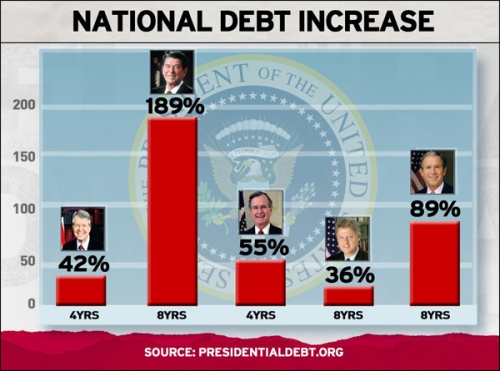
The real argument is the nature of government. The GOP argue that only people with business experience and "pro-business views" should be in government. Pro-business is a coded term for anti-labor or anti-union. However the records of pro-business presidents is not so hot.
Democratic presidents have a much better record of controlling the national debt and the deficit. In many respects the government is a mirror image of private enterprise. After the government collects taxes, its mission is roll the tax revenues back into the economy and to produce the most bang for the buck. The government is not motivated by profit.

Certainly there have been spirited arguments on how to spend the national treasure. The Democrats want to spend the revenues on infrastructure and social programs. The Republicans want to increase defense spending which is at historic highs. The US now produces half of the arms in the world.

The Republicans also advocate a perverse form of Keynesian  called supply side economics. Indeed, lowering taxes and increased government spending will stimulate an economy in an emergency situations like the Great Bush recession that started in 2007.

But the GOP gives the lion's share of the tax cuts to the affluent who they call the "most productive members of society." After 20 years of supply side economics of Ronald Reagan and the two Bush presidents, Americans have gained little from that grand experiment.

As Bob Herbert write in a recent editorial, Republicans need rehab. There ideas are not backed up with empirical data and worse, most of their ideas haven't worked.

Republicans have been smoking their ideological "wacky tobacky" for far too long.

The so-called party of ideas has become the party of bad ideas. Even many Republicans know this and half of the GOP wants a new party. Unfortunately many conservatives want to wander even farther to the right.

What do we need in government? Rightrdia would prefer to see politicians form a broad cross section of America to include teachers, fire fighters, police, college professors and working men and women.

If the founders thought there was a primacy of businesses or corporations, they would have written this into the constitution.

"(T)he Preamble demonstrates that the federal government of the United States was not created as an agreement between or coalition of the states. Instead, it was the product of "the People" with the power to govern the People directly, unlike the government under the Articles of Confederation, which only governed the People indirectly through rules imposed on the states. (Wikipedia)."

Should a corporate oligarchy or plutocracy direct the United States? This is not what the Founders had in mind.

Subscribe to the Rightardia feed: http://feeds.feedburner.com/blogspot/UFPYA    
Netcraft rank: 5484 http://toolbar.netcraft.com/site_report?url=http://rightardia.blogspot.com Creative Commons License

Rightardia by Rightard Whitey of Rightardia is licensed under a Creative Commons Attribution 3.0 Unported License.

Permissions beyond the scope of this license may be available at rightardia@gmail.com.

Tuesday, April 5, 2011

Republicans will close down the government


The Republicans are on the edge of closing the government down and it will take two months for the Democrats to overcome two GOP filibusters in the Senate to restore government operations.

According to the Huffington Post, "The Speaker (John Boehner) told the president that the House will not be put in a box and forced to choose between two options that are bad for the country (accepting a bad deal that fails to make real spending cuts, or accepting a government shutdown due to Senate inaction),"

The House has instead proposed a one-week spending bill that would cut government spending by $12 billion while funding the military through the end of September, when the fiscal year ends.

House Democrats quickly rejected the offer. House Minority Whip Steny Hoyer (D-Md.) told reporters it was time to put an end to the "sporadic, episodic" stop-gap bills and reach a final agreement. He said that Democrats would whip opposition to the House bill if it is brought to the floor.

House Republicans aren't willing to take yes for an answer, Hoyer said, and were demanding far more than they were entitled by their partial control of the government, noting that Democrats control the Senate and White House. Hoyer added:

You would think if you're going to reach a compromise, we get two, they get one. It appears that one side doesn't want to compromise. 


If you think government shutdowns are common, they aren't . According to Wikipedia, there have only been four federal government shut-downs in the history of the US:

This will be the third GOP shutdown since 1990.

In October 1990, Democrats in Congress sought to reduce the federal deficit by implementing a surtax on the income of millionaires.

Republican President GEORGE H. W. BUSH followed through on a threat to VETO any budget legislation that included tax increases.  The veto effectively shut down several federal agencies.

The 1995 "shutdown" of the United States federal government was the result of a conflict between Democratic President Clinton and the Republican-controlled Congress over funding for Medicare, education, the environment and public health.

It took place after Clinton vetoed the spending bill which Congress sent him. The Federal government put non-essential government workers on furlough and suspended non-essential services from November 14 through November 19, 1995 and from December 16, 1995 to January 6, 1996 . . .


The major players were President Bill Clinton and the Speaker of the U.S. House of Representatives Newt Gingrich. Gingrich lost his speakership over the shut down, adultery and by insulting Barbara Bush.

Read more: Federal Budget - Government Shutdown - Congress, Billion, President, Deficit, Democrats, and Surplus http://law.jrank.org/pages/6762/Federal-Budget-Government-Shutdown.html#ixzz1IgF0u200

Subscribe to the Rightardia feed: http://feeds.feedburner.com/blogspot/UFPYA   Netcraft rank: 6237 http://toolbar.netcraft.com/site_report?url=http://rightardia.blogspot.com Creative Commons License
Rightardia by Rightard Whitey of Rightardia is licensed under a Creative Commons Attribution 3.0 Unported License.
Permissions beyond the scope of this license may be available at rightardia@gmail.com.

Thursday, August 19, 2010

WH Blog: Seniors Already Seeing Lower Prescription Drug Costs


Posted by Secretary Kathleen Sebelius on August 18, 2010 at 4:49 PM EDT

The Affordable Care Act is working to help bring down the cost of prescription drugs for seniors enrolled in the Medicare Part D prescription drug program and today, we got more good news for our seniors.

This afternoon, the Centers for Medicare & Medicaid Services (CMS) announced that Medicare prescription drug plan premiums for 2011 will stay similar to rates beneficiaries are currently paying this year.

The average premiums in 2010 were $29 per month -- in 2011 we expect average monthly premiums to be just a dollar more. All beneficiaries should check to make sure that the plan offerings that will be available in 2011 are right for them when information on those plans becomes available in October.

While there has been almost no change in premiums for 2011, people with Medicare will see big improvements in drug coverage next year.

Under the Affordable Care Act, they will see lower prescription drug costs, if they fall into the coverage gap or "donut hole." This year, people with Medicare who are in the donut hole are receiving one-time $250 rebate checks.

Next year, they will receive 50% discounts on brand-name drugs and in each year their costs will be reduced even more until the donut hole is closed in 2020 - meaning that after 2020 there will be no more coverage gap, and people with Medicare will just pay their normal cost-sharing amount until they reach the annual out-of-pocket limit.

And just like President Obama promised -- guaranteed benefits for the seniors and persons with disabilities who rely on Medicare won't change.

The Affordable Care Act was designed to strengthen the Medicare program and ensure that it will continue to provide health security to our seniors for many years to come. Today's announcement -- just like the recent news that the Affordable Care Act will help extend the life of the trust fund by 12 additional years -- is good news for them and their children.

The Affordable Care Act also means less disruption for people with Medicare. Low-income seniors often have to change prescription drug plans every year to find a plan with no premium.

Now, more beneficiaries with limited income will be able to keep their plan if they want to while continuing to have a wide range of plans to choose from if they want to change plans.

General information about premiums and benefits for each Part D and Medicare Advantage (MA) plan will be announced in September on www.cms.gov, and more detailed information to help beneficiaries review their plan options will be available in October at www.medicare.gov.

In addition, each autumn, the comprehensive Medicare & You handbook and other program updates are mailed directly to beneficiaries' mailboxes with important information about health plans, prescription drug plans, and rights and protections to help people with Medicare, their families and caregivers review coverage options.

More information on how the Affordable Care Act will continue to strengthen and improve Medicare is available at www.HealthCare.gov, a new web portal.

Kathleen Sebelius is Secretary of Health and Human Services

Subscribe to the Rightardia feed: feeds.feedburner.com/blogspot/IGiu

Netcraft rank:
9779 
http://toolbar.netcraft.com/site_report?url=http://rightardia.blogspot.com


Monday, July 13, 2009

Steve Kangas FAQ on liberalism: How America was really built

Editor's Note: History does not treat Republicans well. This may explain the anti-intellectualism and anti-university bias that is common in the GOP.


Myth: Early Americans built this land on rugged individualism.

Fact: They were helped a great deal by the government and a strong community spirit.


Summary

The U.S. government played a vital role in settling the West, including massive land purchases and giveaways, the Homestead Act, the Pony Express, agricultural colleges, rural electrification, telephone wiring, road-building, irrigation, dam-building, farm subsidies, and farm foreclosure loans. Without such help, settling the West would have been nearly impossible.


Argument

Most Americans have accepted the myth that early Americans were rugged individualists, pioneers who blazed trails into the Western hills and overcame adversity on the strength of their own self-reliance.

'Tain't necessarily so.

Entire books could be written about how white Americans got rich off the labor of their slaves, all the while waxing rhapsodic over the virtues of self-reliance. Volumes could be written about the early American women who created extensive social networks and church groups to help each other's families, all the while their men were entertaining the conceit of rugged individualism. But this is an essay devoted to the government's contribution to early American survival, so it will address that topic only:

From the start, the West was not conquered by rifle-toting pioneers, but by the U.S. Army. (Hardly a government "success," to be sure, but the point here is that the stereotype of the lone pioneer conquering the West is a myth.) The government made massive land purchases, without which the conquest of these territories would have been even bloodier. It spent $15 million on the Louisiana Purchase, $25 million on the Texas/California purchase, and $7 million for the Alaska Purchase.

The government then turned around and sold this land below cost, at considerable loss to itself. The Preemption Act of 1841, the Graduation Act of 1854 and the Homestead Act of 1862 all gave away land to pioneers for a song.

The government also played a crucial role in developing these lands. When it came to connecting the Great Lakes to the Eastern seaboard with canals, the government funded or financially guaranteed three fourths of the $200 million project.

It also gave each state 30,000 acres of land to build agricultural colleges. It would be difficult to overstate how important these colleges were in advancing agricultural education and techniques among the farmers. With their help, American farmers were quickly able to create a working agricultural economy. Meanwhile, the government provided mail services like the Pony Express that interconnected this economy.

At the farthest edges of the frontier, the settlers were literally lawless; gun-fighting and dueling were rampant. It was only when the government moved in that law and order and a sense of community were established. Disease, attacks from Native Americans and economic chaos at the frontier often turned towns into ghost towns overnight. Not surprisingly, group survival proved more effective than true hermitism.

Historian John Mack Farragher described life on the frontier as "a community experience… Sharing work with neighbors at cabin raisings, log rollings, hayings, husking, butchering, harvesting or threshing were all traditionally considered communal affairs… [A] 'borrowing system' allowed scarce tools, labor and products to circulate for the benefit of all." One pioneer told prospective settlers: "Your wheel-barrows, your shovels, your utensils of all sorts, belong not to yourself, but to the public who do not think it necessary even to ask a loan, but take it for granted."

The government continued to develop the West in the early 20th century. It constructed dams and subsidized huge irrigation projects. During the Great Depression, rural electrification programs brought electricity to farmers, which enabled them to use power tools, refrigeration and household appliances to make their work and personal lives easier. The government also built highways into the West, and wired the countryside for telephone service. The government saved countless small farmers by giving them loans to stall foreclosures and tide them over the rough times. And it began paying huge farming subsidies that continue to this day.

Even then, it was not the small pioneer, but the major corporation that settled the West, often with vast help from the government. By the turn of the century, the government had distributed a billion acres of land, but only 147 million became homesteads.

Sociologists Scott and Sally McNall estimate that "probably only one acre in nine went to the small pioneers." Some 183 million acres were ultimately given to the railroad companies. (It was these federal giveaways that created the major logging companies, not family businesses.) Four out of five transcontinental railroads were built in this way, and Congress approved loans up to $48,000 per mile to build them.

The West has a rich tradition of dependency on government. As historian Stephanie Coontz says: "It would be hard to find a Western family today or at any time in the past whose land rights, transportation options, economic existence, and even access to water were not dependent on federal funds."

Paradoxically, however, the West has also enjoyed a long tradition of anti-government sentiments. When John Wayne punched out "Mr. Government Bureaucrat" in a Hollywood Western, he was acting out the misplaced rage of many Western Americans.

In closing, the story of the Montana Freemen is especially revealing. This is the radical anti-government militia that kept the FBI at bay in an armed stand-off that lasted for months. It turns out that they had stalled foreclosure on their farms for ten years by accepting $676,082 in government farming subsidies and loans.

Apparently, government assistance makes one ungrateful.

http://www.huppi.com/kangaroo/L-west.htm

Get 30 days of free traffic analysis simply by going to Web-Stat: http://www.web-stat.com/?id=2955

Contact Rightardia: eelder1@gmail.com

Subscribe to the Rightardia feed: feeds.feedburner.com/blogspot/IGiu

Netcraft rank: 66069