UA-9726592-1
Showing posts with label Income Tax rate. Show all posts

Friday, April 13, 2012

Seventy six per cent of public backs ‘Buffet Rule’ to have rich share tax load

Some lobbyists such as the U.S. Chamber of Commerce say the Buffett Rule would hurt small businesses. But of the U.S. small businesses reporting income, 74 percent earn below $100,000 annually and 72 percent (many sole proprietors and business owners) also report income in addition to their business, the report shows. This means that “the small share of taxpayers with small-business income in the millionaire category suggests that tax reform policies designed to ensure adherence to the Buffett Rule will affect few small businesses.”


. . . But the public still likes the idea of shared sacrifice, according to a United Technologies-National Journal Congressional Connection poll. It found that 76 percent of Americans support the Buffett Rule, versus only 19 percent who are against it. So opponents and defenders of the 1 percent resort to misleading attacks.


Could this be the end of supply side economics? Rightardia hope so. It never worked. 


graphic: http://www.reviewatlas.com

source: Public backs ‘Buffet Rule’ to have rich share tax load

Subscribe to the Rightardia feed: http://feeds.feedburner.com/blogspot/UFPYA
Creative Commons License


Rightardia by Rightard Whitey of Rightardia is licensed under a Creative Commons Attribution 3.0 Unported License.

Permissions beyond the scope of this license may be available at rightardia@gmail.com.

Friday, July 22, 2011

NewMax: Half of Those Earning $250,000 or more Paid Zero Taxes

Yep, Rightardia got an email about this from NewsMax. Here is the link:
http://w3.newsmax.com/newsletters/franklin/zero_tax_2011.cfm?s=al&promo_code=CA80-1


This is the book that NewsMax is trying to hawk.

According to FactCheck.org, roughly one in 50 households will take in $250,000 or more next year.


Those reporting adjusted gross income of more than $250,000 to the IRS are projected to make up the top 2 percent of households next year. These high income folks will earn 24.1 percent of all income, and pay 43.6 percent of all personal federal income taxes according the Tax Policy Center figures.

According to NewsMax, nearly half of them pay no income tax at all.


Subscribe to the Rightardia feed: http://feeds.feedburner.com/blogspot/UFPYA   Netcraft rank: 6627 http://toolbar.netcraft.com/site_report?url=http://rightardia.blogspot.com Creative Commons License
Rightardia by Rightard Whitey of Rightardia is licensed under a Creative Commons Attribution 3.0 Unported License.
Permissions beyond the scope of this license may be available at rightardia@gmail.com.

Monday, June 20, 2011

The Tax Cut ruse


Tax cuts never have created jobs, they never will. 

You don't even have to be a rocket scientist to figure this one out. 

You rarely hear of someone claiming that after this or that tax strategy their business really took off. 

No, you'll hear business owners talk about advertising, or a new marketing technique, or a new product, or new manufacturing process, or maybe even their own brilliance or something, but you'll rarely find someone in business crediting their success to this or that tax cut. 

That doesn't mean business owners won't cry for tax reductions, and that doesn't mean they won't try to claim that tax reductions result in more jobs. 

But when you get down to brass tacks, few, if any, business types will try to claim that a few percentage points in tax rates have much to do with the success or failure of their business, and those who do, weren't really all that good at business anyway. 

The engine that drives any business is its customers. Period. No customers, no business. 

If customers can't buy your goods or services, your business will never succeed, even if you cut the tax rate to zero. 

If a "welfare" recipient has more disposable income because of a government allotment, that money often ends up at their local 7-11 or something, helping its bottom line. 

If "beer and ciggie" sales decline because of a cut-off of government funding (like food stamps), the local 7-11 sure isn't going to hire another clerk, in fact if sales are hurt enough nationally, the whole chain may go out of business. 

That sure doesn't increase jobs. Furthermore, the ripple effect of the chain closing may indeed hurt the Slurpee machine manufacturer, the company that supplies paint for the convenience store parking lots, and it may even force building contractors out of business because they have to compete with the inventory of vacant convenience stores. 

Hey, but tax rates are lower. I never, ever based my hiring or firing decisions on my tax rate, rather it was based simply on whether customer demand was there. I'd piss and moan about taxes constantly, no matter who was in office, but I never blamed my business success or failure on tax rates. 

Show me a person who makes enough to worry about tax rates and I'll show you a person who has the wherewithal to legally avoid (not illegally evade) much of their tax "burden."

Rightardia posted another article on this topic that suggested that Rick Scott's cuts to the Florida corporate income tax rate is irrelevant. Only 5,000 Florida businesses pay corporate taxes and they are the large C-corporations. 

Since Florida S-corporations pass their tax liabilities to the owners and share holders, these corporations pay no Florida corporate tax. 

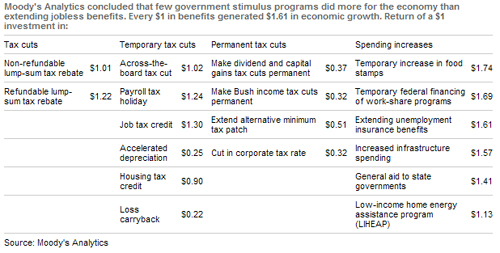
Moody's Analytic's also discovered that tax cuts are one of the least successful ways to stimulate the economy. Mark Zandi researched this table and he was a consultant in the 2008 John McCain campaign. 

source: 
From: Galen Hekhuis 
Newsgroups: talk.politics.misc,alt.politics,alt.politics.liberalism,alt.politics.obama,alt.society.liberalism,alt.politics.usa
Subject: Tax  cuts do not create jobs
Date: Mon, 20 Jun 2011 11:36:41 -0400

Subscribe to the Rightardia feed: http://feeds.feedburner.com/blogspot/UFPYA  
Netcraft rank: 6266 http://toolbar.netcraft.com/site_report?url=http://rightardia.blogspot.com Creative Commons License


Rightardia by Rightard Whitey of Rightardia is licensed under a Creative Commons Attribution 3.0 Unported License.

Permissions beyond the scope of this license may be available at rightardia@gmail.com.

Thursday, April 21, 2011

Most of Americas' problem relate to the distribution of the national treasure


The distribution of the wealth and income in the US is lopsided. after the great depression, the government heavily taxed the most affluent Americans to pay for the war and also launch the economic recovery that started after the war ended.

Since 1980, the GOP reversed the tax reforms of the New Deal with the voodoo concepts in supply side economics. The most affluent American now pay a 35 per cent  income tax rate that is only marginally different form the rate of the average American.

As Politifact points out, the most affluent Americans make less than 20 per cent of their income from working. Most of the income comes from capital gains from stocks, bonds and rental income.

Capital gains is a 15 per cent tax rate meaning most billionaires and millionaires are subject to a lower tax rate than the average middle class family. However, because income distribution in the US is so unequal, 45 per cent of Americans pay no income tax at all. Add that to the other 4-5 per cent of Americans who evade paying federal income tax, about half of the population pays no federal income tax at all.

But that doest't mean many Americans don't pay taxes. All American pay taxes and most pay more in municipal and sales tax than they do in federal income tax. 

Here’s the Politifact rundown of the federal tax burden for the top 1 percent:
  • Federal income taxes: 39.5 percent share
  • Federal payroll taxes: 4.1 percent share
  • Federal corporate taxes: 57.0 percent share
  • Federal excise taxes: 4.7 percent share
The GOP likes to bandy the fact that the affluent pay the lion' share of the federal income tax. As Politifact notes:

Total federal tax share for the top 1 percent: 28.1 percent


So -- using 2007 numbers at least -- Bachmann is off by quite a bit. She’s even further off if you use an estimate for 2010 by the centrist to liberal Urban Institute-Brookings Institution Tax Policy Center, which pegs the share of all federal taxes for the top 1 percent at 22.7 percent.

A bigger question is why a political party who claims to represent the common man would care about the tax burden of the top one per cent of Americans. Listen to Fox News and Rush Limbaugh you will hear about the white man's tax burden of the affluent constantly.

This is why the GOP reforms that tax code when they win the presidentcy and fires or redirects IRS auditors so they can no longer catch high roller tax cheats. When Bush was president, he ordered the IRS to primarily audit people who were applying for earned income tax credits who are the poorest Americans.

sources: Politifiact and http://sociology.ucsc.edu/whorulesamerica/power/wealth.html

Subscribe to the Rightardia feed: http://feeds.feedburner.com/blogspot/UFPYA  

 Netcraft rank: 6018 http://toolbar.netcraft.com/site_report?url=http://rightardia.blogspot.com Creative Commons License
Rightardia by Rightard Whitey of Rightardia is licensed under a Creative Commons Attribution 3.0 Unported License.

Permissions beyond the scope of this license may be available at rightardia@gmail.com.

Tuesday, April 19, 2011

The real problem is taxes have been the one hit wonder for the GOP


While Republican lawmakers are opposed to tax increases and many Tea Party activists want the tax table rates rolled back, federal taxes are at a historic low.

For the past two years, a family of four earning the median income has paid less in federal income taxes than at any time since at least 1955, according to the Tax Policy Center.

In addition. 45 per cent of Americans don't pay federal income tax at at. A the tax tables came crashing down for top earning Americans after World War 2 from 90 per cent to 35 per cent, the Earned Income tax credit exempted millions of low earners from paying federal income tax.

The right wing also carps about the poor who don't pay income tax, but rarely mention that most of these people live in the low wage states in the South and the West.  

Add in the 4-5 per cent of tax scofflaws who evade paying federal income tax. Many gulf coast fisherman who were not paying income or FICA payroll tax, yet they expected to reimbursement by BP for their fishing losses in the gulf.

The bottom line is that the federal income tax burden has been shifted to the middle calls by the GOP Who promised to reduce taxes but spared that details that their focus on tax relief was for the most affluent Americans.  

All federal, state and local taxes combined are a lower percentage of per-capita income than at any time since the 1960s, according to the Tax Foundation. The highest income-tax bracket is its lowest since 1992.

At 35 percent, it's well below the 50 percent mark of much of the 1980s and the 70 percent bracket of the 1970s.

Raphael Sonenshein, a political science professor at Cal State Fullerton added:

There's this impression that there's a colossal tax burden and that's not really the case,” But if you're really angry at the government, you're going to think taxes are too high.

If you compare he US taxes as a percentage of GDP, the US is in the bottom one third of developed countries. The real problem is the rich isn't paying their fair share of taxes and the poor aren't paying anything at all.

As Steve Kangas has stated:

Liberals . . .view the runaway profits of the rich (especially in the later stages of wealth accumulation) as undeserved, so redistributing them back to the workers who produced them is necessary to prevent exploitation.

In one of the more famous studies, economists Torsten Persson and Guido Tabellini conducted a thorough statistical analysis of historical inequality and growth among modern democracies, and found that t
hose with more equal incomes generally experience faster productive growth. 
 
sources: http://www.ocregister.com/news/-117079-ocprint--.html and http://en.wikipedia.org/wiki/List_of_countries_by_tax_revenue_as_percentage_of_GDP

Subscribe to the Rightardia feed: http://feeds.feedburner.com/blogspot/UFPYA   Netcraft rank: 6103 http://toolbar.netcraft.com/site_report?url=http://rightardia.blogspot.com
  Creative Commons License
Rightardia by Rightard Whitey of Rightardia is licensed under a Creative Commons Attribution 3.0 Unported License.

Permissions beyond the scope of this license may be available at rightardia@gmail.com.

Monday, April 18, 2011

The tax code mess in the US


By STEPHEN OHLEMACHER   04/17/11 04:02 PM ET   AP

WASHINGTON--". . . The super rich pay a lot less taxes than they did a couple of decades ago, and nearly half of U.S. households pay no income taxes at all.

The Internal Revenue Service tracks the tax returns with the 400 highest adjusted gross incomes each year. The average income on those returns in 2007, the latest year for IRS data, was nearly $345 million. Their average federal income tax rate was 17 percent, down from 26 percent in 1992.

. . .There are so many breaks that 45 percent of U.S. households will pay no federal income tax for 2010, according to estimates by the Tax Policy Center, a Washington think tank."

Rightardia agrees with conservatives that more Americans need to pay federal income tax. This includes corporations and the super-rich who have a sweet deal with the capital gains tax. 

See the complete article at 
http://www.huffingtonpost.com/2011/04/17/us-rich-income-taxes-drop-dramatically_n_850174.html

Subscribe to the Rightardia feed: http://feeds.feedburner.com/blogspot/UFPYA   Netcraft rank: 6103 http://toolbar.netcraft.com/site_report?url=http://rightardia.blogspot.com
  Creative Commons License
Rightardia by Rightard Whitey of Rightardia is licensed under a Creative Commons Attribution 3.0 Unported License.

Permissions beyond the scope of this license may be available at rightardia@gmail.com.

Sunday, April 3, 2011

Conservative States Raise Higher Share Of Taxes From The Poor

Conservative States Raise Higher Share Of Taxes From The Poor

Based on Katherine Newman's book, "Taxing the Poor," Ezra Klein comments on how Southern states raise taxes in the most regressive fashion: through sales taxes that fall most heavily on the poor. Klein refers to a chart in the book that shows how state and local taxes vary by region:

Rightardia has written about this innumerable times. The right wing tries to couch taxes in terms of income tax because it is one of the few progressive taxes.

All Americans pay taxes and more tax revenue comes from municipal, property and sales tax  than income tax.

The right wing also carps about the poor who don't pay income tax, but rarely mention that most of these people live in the low wage states in the South and the West. 


source: Conservative States Raise Higher Share Of Taxes From The Poor

Subscribe to the Rightardia feed: http://feeds.feedburner.com/blogspot/UFPYA 

Netcraft rank: 6237 http://toolbar.netcraft.com/site_report?url=http://rightardia.blogspot.comCreative Commons License
Rightardia by Rightard Whitey of Rightardia is licensed under a Creative Commons Attribution 3.0 Unported License.
Permissions beyond the scope of this license may be available at rightardia@gmail.com.

Saturday, January 8, 2011

Freetown Christiania: A left wing approach to dodging taxes


RussiaToday | January 05, 2011 
It started off as a hippie squat but now the self-proclaimed neighbourhood in Copenhagen known as Freetown Christiania is a community where people live by their own rules. No government, no politics, it has been free and available to all for forty years. But now local Danish authorities want to cash in.

The community owns all of the property and the people who live there rent. There are no home sales or real estate speculation.

Although the GOP rails on federal income tax, most Americans pay more in municipal taxes (property and sales tax) than they do in income tax.

Imagine a not-for-profit such as a church in the US that builds homes that are rented to community members and are never for sale. Republicans would not be happy with this approach to dodge taxes that does not allow for profit taking.

The local government would probably want to appraise the property and tax the not-for-profit.

Of interest, local US governments are now charging fees to not-for-profits for improvements like drainage projects if the no-for-profit owns property that would benefit from the project.

Subscribe to the Rightardia feed: http://feeds.feedburner.com/blogspot/UFPYA

Netcraft rank: 6537 http://toolbar.netcraft.com/site_report?url=http://rightardia.blogspot.com

Friday, January 7, 2011

Think you pay too much in taxes?

The GOP wants Americans to think they have this horrible tax burden imposed by a non-responsive government.  The anti-tax manta of the GOP has been its "one trick pony." The GOP, indeed, likes to reduce taxes, regardless of whether this produces a huge deficit.

A weak government is good for corporatism, too. It' harder to assure labor and safety regulations are being broken when you lay off 25 per cent of the inspectors in the Department of Labor as Bush did when he was president.

Want to slow down VA disability pensions. Tell the VA to review all of the ratings at the 50 per cent level or higher. Bush ordered that, too, and it caused a huge backlog in claims that the Obama administration is still cleaning up.

These deficit politics started with Ronald Reagan. George W. Bush continued the deficit politics when he invaded Iraq without raising taxes.

Relative to other Organisation for European Economic Co-
operation and Developement  (OECD) (developed) countries, the US has a very low tax rate. 

"When you look at the overall tax burden, the U.S. is quite low," said Eric Toder, a senior fellow at the Urban Institute in Washington, D.C. Toder was the former director of the office of research for the Internal Revenue Service.

For a family with one wage-earner and two children, only Iceland and Ireland have a lower income tax burden than the U.S., according to the most recent data for 2005.


Citizens in other OECD countries are paying more money, but they are getting more back, in terms of social programs, said Christopher Heady, head of tax policy for the Paris-based think tank Organization for Economic Cooperation and Development, or OECD. 


Its a choice the electorate makes. 

The average American pays wage-based taxes that are similar to what people in the UK and France pay.

Japanese citizens enjoy the lowest rates among the Group of Seven (G-7) large industrial economies. This is in terms of national and local income and payroll taxes.

Add in sales taxes, capital gains taxes, property taxes, and corporate taxes, and the US sends 28 cents of every dollar of output to the government. That still matches Japan for the lowest ratio of tax revenue to gross domestic product (GDP) among the G-7 nations. France and Italy score highest.

sources: http://moneycentral.msn.com/content/taxes/p148855.asp and http://www.csmonitor.com/USA/2010/0411/US-tax-bite-smaller-than-other-nations

Subscribe to the Rightardia feed: http://feeds.feedburner.com/blogspot/UFPYA 


Netcraft rank: 6537 http://toolbar.netcraft.com/site_report?url=http://rightardia.blogspot.com

Sunday, January 2, 2011

TheRealNews: The Great GOP tax scam


TheRealNews | January 01, 2011 

Michael Hudson: History of US shows economy grows when top tier tax rates and workers wages are high. 

This video provides a lot of the history of the US income tax that was instituted by progressive Republicans. The first income tax only affected the top one per cent of income earners with a 90 per cent tax rate. 

Today, the top tier of income earners pays 35 per cent, but most of the income of the affluent is derived from capital gains that is only taxed at a 15 per cent flat tax.

Under the original income tax code, capital gains were taxed as ordinary income.

Today, the top 10 per cent of Americans haul in 50 per cent of the annual national income. This is largely due to the regressive tax policies of Republicans.

Subscribe to the Rightardia feed: http://feeds.feedburner.com/blogspot/UFPYA 

Netcraft rank: 6603 http://toolbar.netcraft.com/site_report?url=http://rightardia.blogspot.com

Friday, December 10, 2010

Class Warfare 101: Most Americans don’t believe hard work will get you rich

A Rasmussen Reports national telephone survey finds that only 26% of Adults believe it’s still possible for just about anyone in America to work hard and get rich.

Fifty-eight percent (58%) do not think a good work ethic will pay off, while 16% more are not sure.

However, a plurality of all Americans (46%) still feel it’s possible for anyone in the United States to work their way out of poverty, but thirty-seven percent (37%) disagree and say it’s not possible to work your way out of poverty. Another 17% are undecided.

But only 41% say it’s possible for anyone who really wants work to even find a job. Forty-five percent (45%) do not think finding work is that easy. Thirteen percent (13%) are undecided. Confidence that jobs are available has been falling since the beginning of last year.

Americans continue to show little short-term confidence in the country’s economic recovery but remain more confident in the long-term..

Only 23% of all adults say today’s children will be better off than their parents. Fifty-six percent (56%) do not believe today’s youth will be better off than their elders. Twenty-one percent (21%) are not sure.

In regard to becoming rich, the IRS has just released an analysis of the richest 400 American tax filers (.pdf) that supports the American belief  that it isn't hard work that makes someone rich.

The top-line finding drawing the most attention is that these 400 earned about $138 billion, collectively in 2007. In contrast, the bottom 90 percent of Americans, over 24 million filers, earned $247 billion.

There are two important things to note from this chart. The first, and most visually apparent, is that the tax rates of the rich are far more closely linked to the capital gains taxes than income taxes. Salaries and wages, the source of income taxed at the blue line, represented only 6.5 percent of these filers’ income.

Nearly two-thirds of their income comes from capital gains, and this is why you see a much tighter coupling between the orange and red lines.

The second thing to note is that the overall tax rates are really not that high. Contrary to concerns about socialism or a government takeover, the richest Americans, those earning an average of $345 million in 2007, paid about 16.5 percent in federal income taxes.

Contrary to what many American believe, Americans pay a marginal income tax rate. This figure is generally not well understood and is certainly not the one we debate in the public sphere. Instead, we generally end up talking about marginal tax rates.

The word “marginal” in this context means you don’t actually pay the full rate of the bracket you fall in.

For example, a single person earning $50,000 in 2009 would technically be in the 25 percent bracket. But they would actually pay 10 percent on their first $8,350 in earnings (the lowest bracket), 15 percent on every dollar between $8,351 and $33,950 (the second bracket), and 25 percent on every dollar between $33,951 and $50,000 (their salary). This works out so that the hypothetical person would actually only pay 17.4 percent of their income in taxes.

Many wealthy people know that working a 9 to 5 job will never make one rich. You become rick by acquiring assets such as really estate, stocks, bonds and precious metals. In most cases, the affluent will pay the lower capital gains taxes from any earnings form these assets.

The capital gains tax was 15 per cent under GW Bush.

source: http://www.livecitizen.com/americans-dont-hard-work-rich/ and http://www.quickanded.com/2010/02/effective-tax-rates-of-the-richest-400-americans.html

Subscribe to the Rightardia feed: http://feeds.feedburner.com/blogspot/UFPYA

Netcraft rank: 7373 http://toolbar.netcraft.com/site_report?url=http://rightardia.blogspot.com

Thursday, November 25, 2010

RED alert: Why we have a deficit in the US

The primary reason we have a deficit in the US is because the GOP started coddling the rich when Ronald Reagan was elected.

If you look at the tables you can see that taxes on the most affluent Americans were extremely low prior to the Great Depression, too.

The net effect of low taxes on the affluent was the middle class was weakened. Wages became stagnant because the top 20 per cent of Americans hauled in half of the national income.

The affluent hold most of the stocks and bonds of this nation and pay only a 20 per cent capital gains tax on their earnings (15 per cent under GWB). Some billionaires like Warren Buffet and Bill Gates have admitted they are under taxed.

The House Republicans want to keep the taxes low on the affluent and cut programs such as Social Security, Medicare, school lunches and  miliary retirement that are the lifeblood of the middle class and the poor. This is simple class warfare.

Rightardia has been looking for this graphic for a long time and finally found it on bartcop

Subscribe to the Rightardia feed: feeds.feedburner.com/blogspot/IGiu 

Netcraft rank: 8281 http://toolbar.netcraft.com/site_report?url=http://rightardia.blogspot.com

Wednesday, October 13, 2010

Dangerous Intersection: Dialog with a Republican.

Tony Coyle | October 11, 2010

My neighbor, B, is a progressive republican and a tax partner in a large CPA firm. We had a conversation…

“Obama needs to go”, said B.

Why? He’s doing pretty well considering the mess he inherited!

“Because all he wants to do is raise taxes! If we don’t get control [of congress and senate] my taxes will go up by almost 20%. I already pay almost half my income in taxes: income, property, FICA and the rest”

What? How do you get a 20% increase?

“FICA – is capped at about 100k. As a partner, I pay FICA at 15%. Lose that cap and my taxes go up immediately by 15%. The top rate of income tax is set to climb to 39%, which is an extra 3%. And there are a bunch of others, too”

No — that’s just wrong. Even assuming that happens… an example, if you earned $200k your effective FICA rate would be 7.5% on that $200k, right? So even without a cap, your effective FICA rate will never be greater than 15%. If you earn $200k, that means an increase of 7.5%, not 15%!

“OK! But that wouldn’t be a 7.5% increase if I earned 300k or 400k or 500k. It would be much greater than 7.5%”


B, Sure it would, but if you earn $500k and can’t absorb that kind of increase, I’d advise you to start looking for a new tax accountant! LOL

“Well ok! But do you think it’s fair that 60% of the people in this country don’t pay any taxes?”

Where did you get that number? Do you think it’s right that the US has such a large population of poor people they fall under the threshold for federal taxes?

“Most of those people aren’t poor!”

But all of them pay taxes. You included property taxes in your 50%. I assume you included sales taxes, 7% for most everything here in GA? Then those people who pay nothing are paying way more in effective taxes than you – for food and energy and shelter.

This is the kind of misinformation that the GOP promulgates. The Federal Insurance Contributions Act (FICA) tax is a United States payroll (or employment) tax imposed by the federal government on both employees and employers to fund Social Security and Medicare.

For 2008, the employee's share of the Social Security portion of the tax is 6.2% of gross compensation up to a limit of $102,000 of compensation (resulting in a maximum of $6,324.00 in tax). The employer provides a matching 6.2 per cent.

For 2009 and 2010, the employee's share is 6.2% of gross compensation up to a limit of $106,800 of compensation (resulting in a maximum Social Security tax of $6,621.60).This limit, known as the Social Security Wage Base, goes up each year based on average national wages. The employee's share of the Medicare portion is 1.45% of wages, with no limit on the amount of wage subject to the Medicare tax.

Because of the cap on Social Security, this part of the tax is regressive and has little effect on the most affluent Americans. When Republicans take the presidency, they often refuse to raise the cap because the tax is starting to effect upper income Americans. Keep in mind this tax has primarily been borne by the middle class since Social Security was instituted in the 1930s.

Wednesday, October 6, 2010

The Gavel: House GOP Whip Eric Cantor’s Plan to Add $2.7 Trillion More to Deficit


According to the nonpartisan Congressional Budget Office, the current tax rate on capital gains is projected to bring in about $1.24 trillion in federal receipts over 10 years. [CBO, 1/10/10]

So eliminating this tax could cost middle-class Americans up to $1.24 trillion over 10 years, while giving even more tax breaks to the wealthiest Americans. For example, the Joint Committee on Taxation indicated that for 2005, 88 percent of the benefit of lower rates for capital gains would go to individuals with incomes over $200,000. [CRS, 2007]

Reducing the top corporate tax rate to 25 percent. It's COST – MORE THAN $734.7 BILLION OVER 10 YEARS [Tax Policy Center, 9/15/08]

A flat tax could increase taxes on the middle class by thousands of dollars a year, while cutting taxes for the top 1 percent by more than $200,000. [Citizens for Tax Justice, 2/19/10]

The Cantor Plan would provide a permanent bailout for billionaires and millionaires (the wealthiest 2 percent of Americans). It's COST – $700 BILLION OVER 10 YEARS [Washington Post, 9/8/10]

Rightardia agress with Nancy Pelosi. The affluent got an 8 year holiday when bush was president. The tax cuts did little for the economy. The people who benefit from capital gains are most affluent Americans and flattening the tax tables would just increase the deficit. The problem with corporate tax is that too many businesses are exempt from it. A twenty five per cent tax rate might work if all corprortions paid the tax and the existing corporate exemptions were rescinded.

Subscribe to the Rightardia feed: feeds.feedburner.com/blogspot/IGiu

Netcraft rank: 8377  
http://toolbar.netcraft.com/site_report?url=http://rightardia.blogspot.com

Tuesday, September 28, 2010

Mediaite: Cenus finds huge wealth gap between rich and poor

The Census Bureau released new data today that suggests a deepening divide between the countries wealthiest citizens and its poorest. According to census statistics, the United States has the greatest disparity between “rich” and “poor” among Western industrialized nations, which spawned commentary from Rachel Maddow via Twitter.

The recession took a dramatic toll on the institution of marriage in America last year, new figures show, with weddings for people 18 and older at the lowest ebb in over a hundred years.

A broad array of new Census Bureau data released Tuesday

Writing for the Associated Press, Hope Yen reported:

The government already had revealed that the income gap between the richest and poorest Americans grew last year by the largest margin ever, stark evidence of the impact the long recession starting in 2007 has had in upending lives and putting the young at greater risk.


The top-earning 20 percent of Americans — those making more than $100,000 each year — received 49.4 percent of all income generated in the U.S., compared with the 3.4 percent earned by those below the poverty line, according to the newly released Census figures. That ratio of 14.5-to-1 was an increase from 13.6 in 2008 and nearly double a low of 7.69 in 1968.

A different measure, the international Gini index or the Gini coefficient, found U.S. income inequality at its highest level since the Census Bureau began tracking household income in 1967. The U.S. also has the greatest disparity among Western industrialized nations.

The disparity in US income is well-known, but the wealth differential is far worse. The US GINI index is 46.8 in 2008. Any index more than .40 can lead to social instability. The GINI index in EU countries is estimated to average .31.


The Federal Income Tax can control income disparity and the Estate Tax can mitigate wealth disparity. Republicans have traditionally tried to flatten the progressive income tax that is now less than 40 per cent for the top tax bracket. GWB also suspended the Estate Tax that only affects the top 5,000 American families.


Because of regressive GOP tax policy, the middle class had been weakened since the Reagan era and some business people are realizing that tax breaks won't help them if they lose their middle class customer base. Of course, Blue Dog Democrats have worked with Republicans so the Democratic Party is not blameless either. Bill Clinton could have also done more to reverse this trend, but he didn't.


It is obvious that GOP ideas and supply side economics will not work in the present economic environment. Giving millionaires $100,000 a year tax breaks will damage the economy further.

Subscribe to the Rightardia feed: feeds.feedburner.com/blogspot/IGiu

Netcraft rank: 8665
 http://toolbar.netcraft.com/site_report?url=http://rightardia.blogspot.com


Powered by ScribeFire.

Tuesday, August 24, 2010

China Daily: Legislature proposes narrowing the gap in wealth

(Xinhua) Updated: 2010-08-24 22:36

BEIJING - China's top legislature, the National People's Congress (NPC), has proposed a reform in income distribution be launched as soon as possible, aiming to increase residents' income and narrow the gap in wealth.

Officials of the Financial and Economic Affairs Committee of the NPC said they have completed a research report on distribution of national income and made the proposals to be included in the 12th Five-Year Plan (2011-2015).

The legislature did not release further details on the proposed reforms in income distribution.

The NPC, for the first time in history, completed 15 research reports on 14 major subjects from March to July to provide proposals for the formulation of the critical development plans for the next five years, after top legislator Wu Bangguo called for the research at the annual legislative session.

According to a World Bank report, the Gini Coefficient for China, a main gauge of income disparity surged to 0.47 in 2009, exceeding the "security line" of 0.4, pointing to the unequal distribution of income which could arouse social unrest.

This figure was 0.21 to 0.27 three decades ago. In the primary distribution of national income, the proportion that goes to wages and salaries, the major source for China's mid- and low-income families, has been declining, according to Yi Xianrong, a researcher at the Chinese Academy of Social Sciences.

The proportion of the total income that Chinese citizens receive from the distribution of national income fell sharply to 57.9 percent in 2007, compared with 68 percent 20 years ago, according to the People's Bank of China.

The Gini coefficient is a measure of statistical dispersion developed by the Italian statistician Corrado Gini and published in his 1912 paper "Variability and Mutability" (Italian: Variabilità e mutabilità).
The Gini coefficient is a measure of the inequality of a distribution, a value of 0 expressing total equality and a value of 1 maximal inequality. It has found application in the study of inequalities in disciplines as diverse as economics, health science, ecology, chemistry and engineering.

It is commonly used as a measure of inequality of income or wealth. Worldwide, Gini coefficients for income range from approximately 0.23 (Sweden) to 0.70 (Namibia) although not every country has been assessed.

US income Gini indices over time

Gini indices for the United States at various times, according to the US Census Bureau:
  • 1929: 45.0 (estimated)
  • 1947: 37.6 (estimated)
  • 1967: 39.7 (first year reported)
  • 1968: 38.6 (lowest index reported)
  • 1970: 39.4
  • 1980: 40.3
  • 1990: 42.8
  • 2000: 46.2
  • 2005: 46.9
  • 2006: 47.0 (highest index reported)
  • 2007: 46.3
  • 2008: 46.69
The simplest way to control the distribution of income in a country is with a progressive income tax in which the higher income levels pay a higher tax rate. In the US the Republican party with the cooperation of Blue Dog Democrats has worked tirelessly to flatten the progressive income tax. The US Gini index is now higher than it was before the Great Depression. 

In the US, an Estate Tax that Republicans referred as a "Death Tax.' although the Estate Tax only effects the top 5000 American families with estates worth more than $1 million, GWB suspended this tax. The suspension will expire in December 2010.


In the short term the GOP tax policies benefit the 'have mores." In the long run, these same tax policies create social instability such as that which occurred during the Great Depression.

source: http://en.wikipedia.org/wiki/Gini_coefficient

http://mapscroll.blogspot.com/2009/04/is-us-becoming-third-world-country.html

Subscribe to the Rightardia feed: feeds.feedburner.com/blogspot/IGiu

Netcraft rank: 9779
http://toolbar.netcraft.com/site_report?url=http://rightardia.blogspot.com


Saturday, August 21, 2010

Businesses claim they are not hiring because of slow consumer spending

With consumers slow to spend, businesses are slow to hire
CHICAGO -- Corporate profits are soaring. Companies are sitting on billions of dollars of cash. And still, they've yet to start hiring or make major investments.

Many Democrats say the economy needs more stimulus. Business lobbyists and their Republican allies say it needs less regulation and lower taxes.

But here in the heartland of America, senior executives say neither side's assessment fits.

They blame their profound caution on their view that U.S. consumers are destined to disappoint for many years. As a result, they say, the economy is unlikely to see the kind of almost unbroken prosperity of the quarter-century that preceded the financial crisis.

Why is consumer spending flagging. A lot of this has to do with Supply Side economics that have weakened the middle class. Cenk Uygur was conducting an MSNBC interview. The interviewee pointed out that he used to be focused on tax cuts until he realized his business couldn't make a profit without customers buying his product or services. 

Supply Side (SS) economics is really blind to importance of consumers to business. The Republican tax breaks are essentially a  subsidy to large corporations and small businesses that assume the businessman are selling the products and services to consumers. Tax breaks to middle class and low income earner under SS economics is modest.

Tax breaks are pointless if profits drop. In addition, Moody's Economics conducted a study which shows that permanent and temporary tax cuts are far less stimulative than food Stamps and unemployment compensation that provide purchasing power to consumers and are quickly rolled back into the economy.

According to the Washington Post, senior executives said they see Americans for years ahead paying down debts incurred during the now-ended credit boom and adjusting spending to match their often-reduced incomes.

Again we have an oversimplification of the problem. The Federal Reserve completed a study that showed the Supply Side Reaganomics devastated the middle class. One third became affluent and the other two thirds reversed or treadled water.

The fate of the middle class did not improve greatly during the Clinton years either.  Bush finished off the middle class during his eight year presidency with his 'tax cuts' that doubled the deficit.

During the  Bush inaugural address , he stated:

“This is an impressive crowd: the Have's and Have-more's. Some people call you the elites. I call you my base.”


It is is an impressive crowd. The top one per cent Americans now haul in 50 per cent of the income and own 90 per cent of the wealth. The only thing would fix the American economy would be huge tax increase on the affluent. This is essentially what FDR did during the Great Depression and World War 2. The top US income earners were in the 90 per cent tax bracket. 

Can the US work its way out of the Great recession. This is doubtful. Banks make their profits by moving paper around and most of the industrial base of the US has been offshored.

Will Democrats have the balls to tax the affluent? That is also doubtful. Most Democrats think even a 40 per cent tax on top income earners is risky.

Executives see little evidence that the economy is slipping back into recession. But they describe a business environment in which sales come in fits and starts and their customers can't predict what they will want to buy in the future.

Why is this? Because the vast middle class that make up the bulk of consumers is broke. SS economics will neither help the affluent or the middle class in present predicament the US is in. Income tax cuts won't help businesses that aren't making money.

source: http://www.washingtonpost.com/wp-dyn/content/article/2010/08/20/AR2010082005165.html?hpid=topnews
Subscribe to the Rightardia feed: feeds.feedburner.com/blogspot/IGiu

Netcraft rank:9779 
http://toolbar.netcraft.com/site_report?url=http://rightardia.blogspot.com

Saturday, July 24, 2010

Republicans speak with forked tongues about taxes


The Bush tax cuts are set to expire in December after the election. The GOP is trying to present the expiration of the Bush tax cuts 'as the biggest tax increase in American history.'

This is what George W,. Bush said when he cut taxes for the most affluent Americans:

President Bush said . . .that the most important number in the budget he sends to Congress next week is the $5.6 trillion surplus it projects over the next 10 years. The reality is that Bush doubled the deficit while he was president.

"A surplus in tax revenue, after all, means that taxpayers have been overcharged," the president said.

Democrats cautioned that surpluses projected over so long a period can turn into elusive fool's gold. And they continued to insist that as it stands the Bush tax-cut plan unfairly favors the wealthy over those of more modest means. The Democrats were right.

Mr. Bush said his budget plan proposes a "reasonable" 4 percent growth rate, which he said is "little more than inflation."

He pledged that his spending plans will not neglect the national debt, now totaling about $5.7 trillion.

"After paying the bills, my plan reduces the national debt, and fast," Mr. Bush said. "So fast, in fact, that economists worry that we're going to run out of debt to retire. That would be a good worry to have." The reality is that Bush increased the national debt by $4 trillion, the biggest increase in US history. 

The Bush administration was never big on job creation either, preferring to discuss worker productivity. To see the Bush job creation record, check the chart below:

source: http://www.cbsnews.com/8301-500803_162-4486228-500803.html

Subscribe to the Rightardia feed: feeds.feedburner.com/blogspot/IGiu

Netcraft rank: 14896
http://toolbar.netcraft.com/site_report?url=http://rightardia.blogspot.com

Thursday, July 22, 2010

Are Gulf coast fisherman eligible for Medicare and Social Security?


The gulf coast fisherman who aren't paying Income Tax are likely not paying FICA payroll tax which pays for Social Security and Medicare benefits.

You must pay FICA for 40 quarters (10 years) to get minimal Social Security benefits and also to be eligible for Medicare part A that covers hospitalization, which is free.

Part B covers doctor's visits and the Social Security beneficiary pays a monthly fee for part B and also a $20 co-pay when you visit a doctor office. Part B is optional and retirees do not have to enroll.

The Federal Insurance Contributions Act (FICA) is a federal law that requires most employers to withhold two separate taxes from the wages they pay their employees: a Social Security tax and a Medicare tax.

If you are self-employed, you must also pay these taxes. If you have worked in a job where FICA taxes have been withheld from your paycheck, or if you have paid these taxes as a self-employed worker, you have worked in Medicare-covered employment.

People under 65 must earn a certain number of credits of Medicare-covered employment to get Medicare benefits (depending on their age).

Those 65 and over qualify for free Part A Medicare if they have earned a minimum of 40 credits of Medicare-covered employment. You can earn up to four credits a year, based on your earnings. Most people earn 40 credits in 10 years of work.

The 40 quarters of work is also the minimal requirement for basic Social Security benefits. This special minimum benefit is about $600 per month.

If you want to know how many credits of Medicare-covered employment you have, check your most recent Social Security statement.

If you have not gotten a Social Security statement or would like a more recent one, you may request one by calling Social Security at 1-800-772-1213, or you may request one online: Request a Social Security Statement.

Bottom line: The Gulf coast fisherman may have been making a nice living because they didn't pay taxes, but they are having major problems filing claims with BP because they re unable to document their income with a 1040 or a W-2. 

When these tax scofflaws reach retirement aid, they will probably have to use Medicaid for medical care and get food stamps to eat. The government will provide them with about $600 a month to live on because they won't meet the 40 quarters requirement.

Because many of these fisherman pay no payroll taxes at all, they aren't even eligible for unemployment compensation. Working class people need to rethink their views on tax avoidance and tax evasion.

Most of the people who don't pay taxes are Red Staters like these fisherman.


Subscribe to the Rightardia feed: feeds.feedburner.com/blogspot/IGiu Netcraft rank: 14896 http://toolbar.netcraft.com/site_report?url=http://rightardia.blogspot.com

Wednesday, April 21, 2010

Bill Gates says to tax the rich

CURT WOODWARD | 04/21/10 02:04 PM | AP

SEATTLE--Bill Gates Sr. is leading a new campaign for a state income tax on wealthier residents. Gates says Washington's current tax system is unfair and doesn't supply a steady stream of money for important state programs.

This sets up a bruising political fight in the fall if the measure makes it onto the November ballot. Organizers will need to collect more than 240,000 valid petition signatures by July 2 to qualify Initiative 1077.

Gates, father of the Microsoft Corp. co-founder, is a longtime supporter of tax reform in Washington. He said the issue has been studied extensively without enough action.

"So today, this day, we're going to do something," Gates said.

I-1077 would tax couples with adjusted gross incomes greater than $400,000 annually, or incomes of more than $200,000 for individuals. Supporters say that represents the top 3 percent of earners in Washington.

It also would cut the state property tax by 20 percent and increase the business-and-occupation tax credit to $4,800.

The proposed initiative sets out two tax brackets. The first tax rate would be 5 percent of the portion of joint income that exceeds $400,000, or $200,000 for individuals. The tax would increase to 9 percent on the portion of income that exceeds $1 million for couples or $500,000 for individuals.

Advocates said it would raise about $1 billion per year for education and health programs.

Conservative activist Tim Eyman stood outside the coffee shop hosting Wednesday's income tax announcement to collect signatures for his latest tax-limiting initiative, I-1053. It would reinforce a difficult two-thirds vote threshold for the Legislature to raise taxes.

Eyman said the I-1077 income tax measure would almost certainly make the ballot because of its wealthy supporters. But he didn't think voters would go along, particularly following the Great Recession and fresh state tax increases on beer, soda pop, service businesses and more.

"It is the Holy Grail for the progressive movement," Eyman said. "They probably should have had this event at a church because it requires so much faith."

Most of the state's taxes come from two sources: The 6.5 percent baseline sales tax and the business-and-occupation tax, levied on a business' gross receipts. Property taxes also are in the mix but have relatively strict caps on their annual increase – the consequence of another voter initiative.

Income tax measures have been attempted over the years in Washington with little success. A graduated income tax was enacted by initiative in 1932, passing with about 70 percent of the vote. But it was thrown out by the state Supreme Court, which pointed to the state constitution's call for uniform taxation on property.

Voters have defeated subsequent attempts to amend the constitution for a state income tax, most recently in 1973.

A uniform tax is, of course,  regressive.  Progressive taxes increase the taxable rate as income or the value of an asset increases. Republicans like to describe taxes as 'fair taxes' or 'flat taxes' but these are simply weasel words for a regressive taxes.