According to standard
biographies, the principal Nazi leaders were all born, baptized, and
raised Christian. Most grew up in strict, pious households where
tolerance and democratic values were disparaged. Nazi leaders of
Catholic background included Adolf Hitler, Heinrich Himmler, Reinhard
Heydrich, and Joseph Goebbels.
Hitler did well in monastery school. He sang in the choir, found High
Mass and other ceremonies intoxicating, and idolized priests.
Impressed
by their power, he at one time considered entering the priesthood.
Rudolf Hoess, who as commandant at Auschwitz-Birkinau pioneered the
use
of the Zyklon-B gas that killed half of all Holocaust victims, had
strict Catholic parents. Hermann Goering had mixed Catholic-Protestant
parentage, while Rudolf Hess, Martin Bormann, Albert Speer, and Adolf
Eichmann had Protestant backgrounds.
Not one of the top Nazi leaders
was
raised in a liberal or atheistic family—no doubt, the parents of any
of
them would have found such views scandalous.
Traditionalists would
never
think to deprive their offspring of the faith-based moral foundations
that they would need to grow into ethical adults.
So much for the Nazi leaders’ religious backgrounds. Assessing their
religious views as adults is more difficult. On ancillary issues such
as
religion, Party doctrine was a deliberate tangle of contradictions.
For Hitler consistency mattered less than having a statement at hand
for
any situation that might arise. History records many things that
Hitler
wrote or said about religion, but they too are sometimes
contradictory.
Many were crafted for a particular audience or moment and have limited
value for illuminating Hitler’s true opinion; in any case, neither
Hitler nor any other key Nazi leader was a trained theologian with
carefully thought-out views.
Accuracy of transcription is another concern. Hitler’s public speeches
were recorded reliably, but were often propagandistic. His private
statements seem more likely to reflect his actual views, but their
reliability varies widely.
The passages Christian apologists cite
most
often to prove Hitler’s atheism are of questionable accuracy.
Apologists
often brandish them without noting historians’ reservations. Hitler’s
personal library has been partly preserved, and a good deal is known
about his reading habits, another possible window onto Hitler’s
beliefs.
Also important, and often ignored by apologists, are
statements made by religious figures of the time, who generally—at
least
for public consumption—viewed Hitler as a Christian and a Catholic in
good standing. Meanwhile, the silent testimony of photographs is
irrefutable, much as apologists struggle to evade this damning visual
evidence.
Despite these difficulties, enough is known to build a reasonable
picture of what Hitler and other top Nazis believed.
Hitler was a Christian, but his Christ was no Jew. In his youth he
dabbled with occult thinking but never became a devotee. As a young
man
he grew increasingly bohemian and stopped attending church.
Initially
no
more anti-Semitic than the norm, in the years before the Great War he
fell under the anti-Semitic influence of the Volkish Christian Social
Party and other Aryan movements.
After Germany’s stunning defeat and
the
ruinous terms of peace, Hitler became a full-blown Aryanist and
anti-Semite. He grew obsessed with racial issues, which he unfailingly
embedded in a religious context.
Apologists often suggest that Hitler did not hold a traditional belief
in God because he believed that he was God. True, Hitler thought
himself
God’s chosen leader for the Aryan race.
But he never claimed to be
divine, and never presented himself in that manner to his followers.
Members of the Wehrmacht swore this loyalty oath:
I swear by God this
holy oath to the Fuhrer of the German Reich and the German people,
Adolf
Hitler.” For Schutzstaffel (S.S.) members it was: “I pledge to you,
Adolf Hitler, my obedience unto death, so help me God.
Hitler repeatedly thanked God or Providence for his survival on the
western front during the Great War, his safe escape from multiple
assassination attempts, his seemingly miraculous rise from
homelessness
to influence and power, and his amazing international successes.
He
never tired of proclaiming that all of this was beyond the power of
any
mere mortal. Later in the war, Hitler portrayed German defeats as part
of an epic test: God would reward his true chosen people with the
final
victory they deserved so long as they never gave up the struggle.
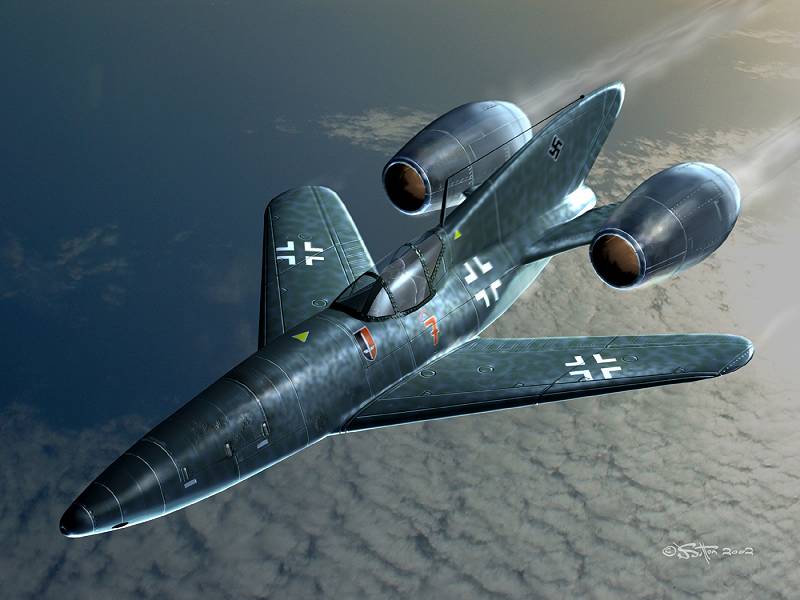
Reich iconography, too, reveals that Nazism never cut its ties to
Christianity. The markings of Luftwaffe aircraft comprised just two
swastikas—and six crosses. Likewise the Kreigsmarine (German Navy)
flag
combined the symbols. Hitler participated in public prayers and
religious services at which the swastika and the cross were displayed
together.
|