UA-9726592-1
Showing posts with label new supranational currency. Show all posts

Monday, May 30, 2011

China Daily: Over-reliance on US dollar


Updated: 2011-05-30 07:53

By Niu Tiehang
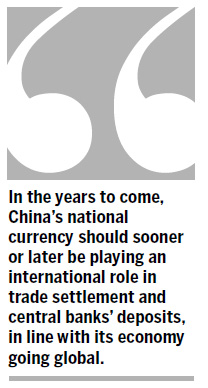
Over-reliance on US dollar(China Daily)There are two sharply contrasting arguments to explain the global imbalances between the United States as the biggest trade deficit country and China as the biggest trade surplus country.

The first argument blames China as the major source of the imbalances, while the other seeks more fundamental reasons within the international monetary system (IMS) itself.

In fact, both arguments are two sides of the same coin. On the one side, the world economy is based on the US dollar, and the US dollar has always been regarded as a "public bus", providing a "free ride" to other currencies.

Apart from the network externality value to the US of widespread dollar usage, such a position also has an obvious economic advantage, known as "seigniorage". In return for injecting liquidity into world trade and investment, the US government, in exchange, receives goods and services from other countries.


Seigniorage can be realized only under two conditions: One is that the currency must be international; the other is that the issuer must be a sole or dominant importer.


In the past six-plus decades, the US dollar has played a pivotal role as catalyst for the post-war international trade and economy, which has enjoyed the greatest rate of development ever known.

But as time has passed, the US dollar has been constantly injecting excessive liquidity into the world economic system. As a result, the US has accumulated a huge trade deficit, shared between 91 countries, among which China and Japan are the largest.

The US has fulfilled the two above-mentioned conditions for seignorage, despite possible conflicts of interest between short-term domestic and long-term international economic objectives - the so-called Triffin Dilemma, which was identified by Professor Robert Triffin in the late 1950s.

In 2009, Governor Zhou Xiaochuan of the People's Bank of China raised the question of whether the world would benefit from a supra-national currency, ideally the International Monetary Fund (IMF) Special Drawing Right, to avoid the risks of the Triffin Dilemma.

However, there is no certainty that this artificially created supra-national currency will ever come into being, so the practical issue confronting the world is this: If the creator of an international reserve currency cannot eliminate the Triffin Dilemma on its own, can the burden be shared with other emerging currencies, such as the Chinese renminbi, Brazilian real or Indian rupee, to make the global economy more balanced?

Such a choice should be based mainly on the economic and demographic weights of major IMS participants. For instance, the US' share of the world economy amounts to about 23 percent, but the US dollar is widely used in 70 percent of world trade and 67 percent of international reserves.

The euro comprises 26 percent of the world's foreign exchange reserves, while the EU's voting power in the IMF surpasses that of the US.

China is now the world's second largest economy, and the top exporter, but its voting power in the IMF has barely climbed above the 4 percent level.

Monday, December 20, 2010

Before It's News: Russia and China to dump the dollar as reserve currency?

Russia is proposing a "currency alliance" with China that would dump the dollar as a reserve currency in the two countries spheres of influence. The new currency could be the Russian ruble, or something both China and Russia agree on.

Russia wants the ruble to be one of the world’s reserve currencies as President Dmitry Medvedev renews his push to reduce the dollar’s dominance and make Moscow a global financial hub.

“Only three, five years ago it seemed like a fantasy” to create a new reserve currency, Medvedev said yesterday in a speech in St. Petersburg, Russia. “Now we are seriously discussing it.”

Russia has been dumping U.S. Treasuries for the past 5 months. Things are not going well for the United States as Russia takes on a new nationalism and blames the West for its economic troubles.

Right wing media has been really talking down the US economy and suggesting the dollar will be dumped as the world's reserve currency. This would mean the majority of international trading would be in currency other than the dollar and it would have a negative effect on the US dollar and the US economy. 

The wingers have been suggesting the US currency would be dumped internationally if the US devalues the dollar. The US has been trying to get the Chinese to revalue their currency upwards because of the trade imbalance.
 source: Stansberry & Associates

The wingnuts have also suggested if the US looses the dollar as reserve currency, it would push this nation into a depression because the US would be unable to print currency.

Of course, any nation can print currency, but it would have a more pronounced affect when the extra currency in not diluted by international markets. 

source:
http://beforeitsnews.com/story/82/114/Russia_Seeks_Chinese_Alliance_for_New_World_Order.html

source: Bob Livingston email, Fri, Dec 17, 2010 at 12:08 PM


Subscribe to the Rightardia feed: http://feeds.feedburner.com/blogspot/UFPYA

Netcraft rank: 6974 http://toolbar.netcraft.com/site_report?url=http://rightardia.blogspot.com
Rightardia.blogspot.com


Tuesday, September 8, 2009

Russia Today: Unero to replace 'toxic' dollar?

08 September, 2009, 22:22


A new report from the United Nations recommends the role of the dollar as a reserve currency should be reduced. Instead, it proposes a new supranational currency.

The US economy is running an enormous deficit and is suffering from unemployment. This country seems to have no other option but to continue printing dollars, making the greenback cheaper – and making foreign held debt less valuable while US goods get a competitive bonus.

The dollar is the most widely used currency in the world, and this makes the global economy dependent on the policies of the Federal Reserve.

“With the US, it’s great if they have the world reserve currency, and everyone needs to buy US dollars to conduct their business,” financial expert Max Kaiser told RT. “And this is why countries like Russia and China and Brazil are trying to divorce themselves from the US, because it’s a completely toxic currency that’s just right for the continuing fraud.”

“It supports an empire that’s just too lazy to compete,” he added.

The idea of a supranational currency, independent of sovereign states, is not a new one. But this is the first time an institution of such importance has made the proposal.

The United Nations says it wants to go back to the idea of Special Drawing Rights, or SDRs, and make it into a proper currency. The International Monetary Fund would then provide liquidity when and where it is needed.

“The IMF could act as a World Central Bank that steers the global money supply,” Detlef Kotte, an economist at UNCTAD, explains.

But more importantly, why do countries need to hold foreign exchange reserves? According to Kotte, they need to hold them largely in order to prevent speculative attacks on their currencies.

“If we established an exchange rate system that would guarantee more stable exchange rates, the need for foreign exchange reserves would be much reduced. Therefore, in our report, we focus very much on the reform of the international system to determine the exchange rates,” Detlef Kotte said, expanding on the idea of the UN proposal.

The idea would allow for a more united global financial policy, reducing the risk of crises like the one we are all in now, which has been widely blamed on the United States.

But, as economists point out, the dollar’s dominant role was formed over the past 15 years, and it will take decades to change that.

“There should be a single economic space which should be used as a source of growth for the rest of the world, as the US does now, for example,” Vladimir Osakovsky, the head of Strategy & Research at Unicredit Bank said. “It is possible, in the end. Eventually, we are moving in that direction. But it’s a very long-term task for global policy makers.”

Meanwhile, global economies are reducing the proportion of dollars in their reserves. As for private investors, they move away from the dollar by moving into safe havens – such as commodities like gold, which has recently breached 1,000 dollars per ounce and could go even higher.

http://www.russiatoday.com/Top_News/2009-09-08/un-dollar-replace-us.html#


Get 30 days of free traffic analysis simply by going to Web-Stat: http://www.web-stat.com/?id=2955

Subscribe to the Rightardia feed: feeds.feedburner.com/blogspot/IGiu

Netcraft rank: 11179 http://toolbar.netcraft.com/site_report?url=http://rightardia.blogspot.com

Powered by ScribeFire.